


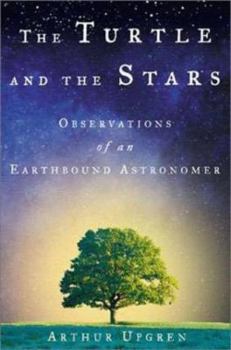
The Turtle and the Stars: Observations of an Earthbound Astronomer


Select Format
Select Condition 
Book Overview
An enchanting look at the heavens that unlocks the sky's mysteries and celebrates the beauty of the universe. No matter where we travel on Earth, the sky is the one great constant, bearing extraordinary colors and images in every kind of weather. Modern astronomy has revealed many secrets of the sky, and now the most intriguing ones have been distilled for a popular audience. With illustrations and engaging text, "The Turtle and the Stars" brings stargazers face-to-face with facts and lore. Topics include: What color is the atmosphere of Mars, and might it someday appear as blue as ours? How does the Milky Way cast shadows? Why is it that we never see the sunset as it's actually occurring? Earthly questions range from why the Taj Mahal glimmers when you gaze up at it to why the top of the Empire State Building travels farther than its lower floors each day. With contagious enthusiasm, Arthur Upgren also invites us to contemplate the natural beauty of the universe through recollecting scenes such as a leatherback turtle depositing her eggs under a sky lit only by Venus, or witnessing a total solar eclipse in Venezuela. A treasure trove of facts sprinkled with references to history, literature, film, and music, this is the ultimate tour for armchair astronomers and naturalists alike.
Format:Hardcover
Language:English
ISBN:080507094X
ISBN13:9780805070941
Release Date:May 2002
Publisher:Times Books
Length:304 Pages
Weight:1.20 lbs.
Dimensions:9.7" x 1.0" x 6.2"
Customer Reviews
1 rating
Could have been a really great book
Published by Thriftbooks.com User , 23 years ago
This book really got my attention because I was a hobbyist astronomer many year's back. It's a fascinating subject. Mr. Upgren intended to write a bunch of rambling essays on the subject, while teaching some basics at the same time. This would be in the manner of Arthur C. Clark and H.A. Rey (also of "Curious George" fame). It could have been a much better book if:a) Mr. Upgren did not harp on the dark-skies issue in many of the chapters, and adding up to about 1/4 of the book. Granted, I think he's right about the uselessness of outdoor lighting wasting energy to the night sky. However, he goes way overboard on this, to great detriment of the book. It could have been in one epilogue chapter at the end.b) the author explained what the turtles have to do with the rest of the book cause it's not really clear to me (oh, yeah they can navigate pretty well in dark skies, whoopeee!).c) the writing were of the quality of Arthur C. Clark. It's not, but pretty readable anyway.I did note that the basic math, on distances to the horizon, center of mass of earth/moon system, etc. seemed right. In fact, I noted no math/numerical errors, which is amazing in and of itself.Very interesting; just ignore the preaching about the streetlights.
Copyright © 2026 Thriftbooks.com Terms of Use
| Privacy Policy | Do Not
Sell/Share My Personal Information | Cookie Policy | Cookie Preferences | Accessibility Statement
ThriftBooks® and the ThriftBooks® logo are registered trademarks of Thrift Books Global, LLC
ThriftBooks® and the ThriftBooks® logo are registered trademarks of Thrift Books Global, LLC
