


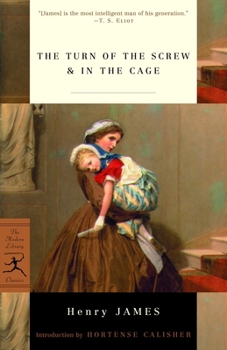
The Turn of the Screw & In the Cage

Select Format
Select Condition 
Book Overview
This Modern Library Paperback Classics edition brings together one of literature's most famous ghost stories and one of Henry James's most unusual novellas. In The Turn of the Screw , a governess is haunted by ghosts from her young charges past; Virginia Woolf said of this masterpiece of psychological ambiguity and suggestion, We are afraid of something unnamed, of something, perhaps, in ourselves...Henry James...can still make us afraid of the dark. In his rarely anthologized novella In the Cage , James brings his incomparable powers of observation to the story of a clever, rebellious heroine of Britain's lower middle class. Hortense Calisher, in her Introduction, calls it a delicious story, the more so because it confounds what we expect from James.
Format:Paperback
Language:English
ISBN:0375757406
ISBN13:9780375757402
Release Date:May 2001
Publisher:Penguin Random House LLC (No Starch)
Length:256 Pages
Weight:0.69 lbs.
Dimensions:0.6" x 5.2" x 8.1"
Customer Reviews
2 ratings
Classic Ghost Story
Published by Thriftbooks.com User , 16 years ago
Turn of the Screw is a lot different than some of the other things that I've read by Henry James--he is said to have a pretty wide range of styles and subject matter. Some of his later novels, especially, delve into the Modernist preoccupation with interiority--what's going on in someone's mind instead of focusing on the plot/action of the story. I enjoy this aspect of Modernism, but it can be difficult to follow and many people do not like reading stream-of-consciousness. In contrast, I would say that Turn of the Screw is the most accessible of James's work that I have read thusfar. The focus is on the plot and the story moves fairly quickly--I read the novelle in just a couple of hours. Moreover, it's a ghost story--and who doesn't love a good ghost story? I found the story riveting and entertaining.
Sinister, spellbinding, suspenseful, and very hard to put down!
Published by Thriftbooks.com User , 19 years ago
Turn of the Screw may be the best haunting story I've ever come across. James is masterful in his unfolding of the tale. His quiet, subtly restrained manner in which he inspires a sense of discomfort and unease in the reader. This story was 'just right', in that everything felt natural and in-character. There was no abruptness, no sense of 'hmmm, page 100 already? Better wrap this up!', no Scooby-Doo sort of ending. He figuratively turns the screw on the reader, by never easing up the tension of the story. Instead, he slowly increases the feeling of dread. I have not yet read "In the Cage", but eventually plan to. The first story alone made it well worth the purchase price. The one thing I didn't like was the footnotes. The person who wrote the footnotes should be repeatedly and stingingly slapped with the flat open palm of someone's hand (I'll volunteer for the job). If you have any background in English literature (i.e., you read and understood the Brontes, Jane Austen or Charles Dickens fairly easily), don't bother with looking them up. You'll be annoyed with the time you've wasted cutting out of the story and flipping to the back, just to see something painfully obvious explained out. If you can't derive most of the context of the stuff that's footnoted, just from reading the book, chances are you're not really going to enjoy this book anyway. That being said, this book still gets five stars from me because I like the fonts and the paper Modern Classics Library uses. I have a number of their books, the bindings seem to hold pretty well, and the cover usually has a tasteful piece of art that usually suits the story inside.
Copyright © 2025 Thriftbooks.com
Terms of Use | Privacy Policy | Do Not Sell/Share My Personal Information | Cookie Policy | Cookie Preferences | Accessibility Statement
ThriftBooks ® and the ThriftBooks ® logo are registered trademarks of Thrift Books Global, LLC
ThriftBooks ® and the ThriftBooks ® logo are registered trademarks of Thrift Books Global, LLC
