


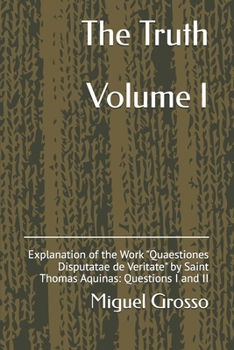
The Truth Volume I: Explanation of the Work "Quaestiones Disputatae de Veritate" by Saint Thomas Aquinas: Questions I and II
No Customer Reviews

The work the reader holds in their hands, titled The Truth. Volume I. Explanation of the work "Quaestiones Disputatae de Veritate" by Saint Thomas Aquinas. Questions I and II, has as its main objective to provide a clear and rigorous guide for understanding one of the greatest contributions of the Angelic Doctor to philosophy and theology. The Quaestiones Disputatae de Veritate (Disputed Questions on Truth), written between 1256 and 1259, represent a testimony to the intellectual intensity and methodological rigor of the medieval Scholastic system. During his first period as a master at the University of Paris, Saint Thomas developed this set of Questions as part of the academic debates characteristic of his time, where complex topics were analyzed in an environment of participatory and argumentative teaching. There are a total of 29 Questions, structured into numerous Articles, which examine the metaphysical, epistemological, and theological dimensions of truth. The quaestio method, characteristic of medieval universities, is the essence of the work. This academic debate format, rooted in classical dialectics, allowed Saint Thomas to pose fundamental questions, consider different perspectives, and reach systematic solutions. Each Article follows a precise structure that includes: The presentation of the topic or Question.The initial objections that challenge the position to be defended.The Sed contra, a citation of authority supporting the correct answer.The Respondeo dicendum, where Saint Thomas presents his argued solution.The responses to the objections, where he refutes or clarifies opposing arguments.Among the topics addressed in the Quaestiones Disputatae de Veritate are the definition of truth as adaequatio rei et intellectus (the adequation between intellect and thing), truth in God as the source and measure of all truth, the relationship between truth and goodness as transcendental aspects of being, and the connection between human freedom and the knowledge of truth. These reflections not only illustrate the depth of Thomistic thought but also establish the foundations for his major works, the Summa Theologiae and the Summa contra Gentiles. This publication not only seeks to explain and contextualize the content of the Quaestiones Disputatae de Veritate but also to guide the reader in exploring the specific topics addressed by Saint Thomas, such as the nature of truth, its immutability, its relationship with the senses, and Divine knowledge. The work has been structured based on a careful reading of the Leonine text translated into English by Robert W. Mulligan, S.J. (Chicago: Henry Regnery Company, 1952), ensuring an interpretation faithful to the original sources. The content is organized systematically, beginning with a general Introduction to the method and context of the work, followed by an analysis of the first two Questions: Truth and The Knowledge of God, with their respective Articles (27 in total), which include profound inquiries such as: What is truth? Is created truth immutable? Does God know singular things? Can God create infinites? The Epilogue is formulated in a question-and-answer format (245 in total), summarizing the content of the entire work.
Format:Paperback
Language:English
ISBN:B0DWXV2ZBG
ISBN13:9798310490123
Release Date:February 2025
Publisher:Independently Published
Length:212 Pages
Weight:0.67 lbs.
Dimensions:0.5" x 6.1" x 9.2"
Customer Reviews
0 rating
Copyright © 2025 Thriftbooks.com
Terms of Use | Privacy Policy | Do Not Sell/Share My Personal Information | Cookie Policy | Cookie Preferences | Accessibility Statement
ThriftBooks ® and the ThriftBooks ® logo are registered trademarks of Thrift Books Global, LLC
ThriftBooks ® and the ThriftBooks ® logo are registered trademarks of Thrift Books Global, LLC
