


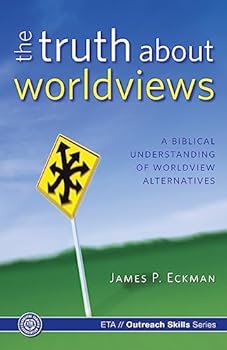
The Truth about Worldviews: A biblical understanding of worldview alternatives


Select Format
Select Condition 
Book Overview
No Synopsis Available.
Format:Paperback
Language:English
ISBN:1929852479
ISBN13:9781929852475
Release Date:October 2014
Publisher:Evangelical Training Association
Length:130 Pages
Weight:0.42 lbs.
Dimensions:0.3" x 5.5" x 8.5"
Related Subjects
Christian Books & Bibles Christian Living Reference Religion Religion & Spirituality TheologyCustomer Reviews
2 ratings
The Truth About Worldviews
Published by Thriftbooks.com User , 19 years ago
While browsing the shelves at a local Christian bookstore last Friday, I came across _The Truth About Worldviews_ (2004, Crossway Books) by James Eckman. I know very little of the author but decided to go ahead with the purchase anyway given the book publisher, whom I've come to trust. The appeal of _The Truth About Worldviews_, as far as I'm concerned at least, is that it's a truncated version (126 pages) of a subject (worldviews) for which there are many lengthy books available. These more ambitious works are appreciated of course, but sometimes it's just nice to read a summary of world religions without having to wade through all the nitty-gritty details and copious footnotes. Eckman's book is "a brief survey of the major worldviews currently dominant in our world today." (p. 13) The major worldviews surveyed are postmodernism, naturalism, Hinduism, Buddhism, Confucianism, Shintoism, Judaism, Islam, the New Age movement, Jehovah's Witnesses, Christian Science, and Mormonism. For each worldview, Eckman provides a brief summary of its history and theology with a view to showing how it differs from Protestant, evangelical theology. This is important to note for you potential book buyers. If you're non-Christian, the evangelical slant may be too much to bear. As Eckman reveals early on, "The overall goal is to inform and equip Christians to live and witness the truth of the gospel in this postmodern world where all worldviews are tolerated." (p. 13) As a conservative, Protestant, evangelical Christian, my first impression of _The Truth About Worldviews_ is that it's well-written and sufficiently informative despite its brevity. Particularly helpful are the "connection points" or "bridges" at the end of each chapter, which suggest common ground Christians should find when first talking religion with people of other faiths. For example, Eckman offers the following as one bridge when talking with Muslims: "Remember that a Muslim is a believer in god. Islam is monotheistic, and Allah shares many of the same attributes as the true God of the Bible. This is the common ground upon which a relationship can be built." (p. 82) Something I found especially helpful in _The Truth About Worldviews_ is the chapter near the end of the book (pp. 105-118), "Roman Catholicism, Protestantism, and Eastern Orthodoxy: What's the Difference?" A year or two ago, I was leading a book discussion group on a university campus. One of the participants was a Hindu from Indian. He asked me on several occasions for a brief summary of the different streams within Christianity. I managed to find some sources for him off the Internet, but I wish I had had Eckman's treatment on the subject back then. It's a clear and understandable, yet fair, explanation of the differences between the three major offshoots of Christianity.
A good book for small group discussion on Worldviews
Published by Thriftbooks.com User , 20 years ago
This is a very clear book on Worldviews from an evangelical protestant perspective. It summarizes major world religions, concisely and clearly. It has practical suggestions on how to build bridges between evangelical Christian and alternative worldviews. It starts with Postmodernism and goes on to describe Humanism, Hinduism, Buddhism, Islam, Confucianism and Shintoism. It then draws distinction between cults and other forms of Christianity. To get the most out of this book you will need Christian beliefs, else you might not agree with the author's viewpoint. However, if you were to have a mixed group of Christians and non-Christians it would make be useful for book reading circles and Bible study groups. Each chapter has questions for further discussion. The most value would be obtained from the book if the group particpants augmented their analysis of the worldviews with additional research from philosophers, religious writings and the web. Obviously in 120 pages one cannot go into much depth, hence the need for more sources. This could also be a good textbook for a course on comparative religion, particularly for Christian schools that want to present ideas from a Christian perspective. You may not agree with the underlying beliefs of the author, but if you do study this either alone or in a group, you will understand where evangelical Christianity is coming from and how it views other worldviews. If you are a Christian it will help you find common ground with those holding other beliefs. If you are a confident, bold Christian it will help you share your beliefs with people from diverse backgrounds. It could also be useful for hiring managers and those who employ immigrants to help them understand the values, beliefs and customs of their colleagues.
Copyright © 2026 Thriftbooks.com Terms of Use
| Privacy Policy | Do Not
Sell/Share My Personal Information | Cookie Policy | Cookie Preferences | Accessibility Statement
ThriftBooks® and the ThriftBooks® logo are registered trademarks of Thrift Books Global, LLC
ThriftBooks® and the ThriftBooks® logo are registered trademarks of Thrift Books Global, LLC
