


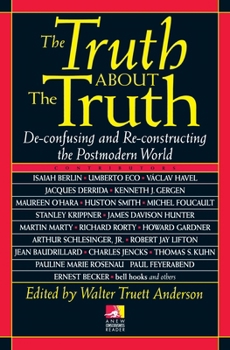
The Truth about the Truth: De-Confusing and Re-Constructing the Postmodern World

Select Format
Select Condition 
Book Overview
Includes essays and excerpts from the works of prominent modern thinkers such as Umberto Eco, Jacques Derrida, and Isaiah Berlin among others.
Format:Paperback
Language:English
ISBN:0874778018
ISBN13:9780874778014
Release Date:August 1995
Publisher:Tarcher
Length:272 Pages
Weight:0.95 lbs.
Dimensions:0.7" x 6.1" x 9.3"
Age Range:18 years and up
Grade Range:Postsecondary and higher
Customer Reviews
5 ratings
The Meta-games of our Cultural Life: A Must Read for all Literate People
Published by Thriftbooks.com User , 17 years ago
This valuable edited volume attempts to answer the question: What's going on in our Culture? What is producing the dramatic changes, the social chaos and even the creativity in the present era? What is giving so many people permission to tinker with the hallowed traditions and symbolic heritage of societies: bypassing long-held myths and mixing old rituals with new traditions like a tossed salad; inventing new personal identities; revising old political ideologies; and picking and choosing between what to believe and what not to believe, as if picking hors d'oeuvres from the table of a corner bazaar? These are the questions this book's thirty-three carefully selected chapters try to answer. The illustrative contributors to this edited book are themselves among the trailblazers of thinking in our modern era. Collectively, they think they see a pattern linking such diverse events as the collapse of Communism, the information revolution, the theological wars within organized religions, terrorism, racism, the Civil Rights movement, and the desperate search for a re-centering of our spiritual values and lives. According to them, the common thread to this turbulent pattern has more to do with a change in how we believe than in what we believe. That is to say, what they see is a "shift in beliefs about belief." To some this is decidedly good news: a new era of liberation; to others, it is a very threatening and grievous lost of a comfortable past, indeed. Modernity pre and post: A Primer The term "modernity" is a "made up word" used to describe the meta-games of cultural life: attempting to describe the grand meta-narratives, or the systemic and global ideas that command, govern and guide our cultural Worldviews, as well as our lives. Pre-modernity was about how to install and maintain in perpetuity a single meta-narrative about our cultural life such as Christianity, Communism, racism, "Manifest Destiny," democracy, and their overarching systems of thought such as rationality, mysticism, belief in faith or some other metaphysic, essentialism, ideology, or science and evolution. Our march out of pre-modernity into modernity has been a series of culture shocks, only matched by the current pains in moving form modernity to post-modernity. These authors tell us that Modernity is now being eclipsed by post-modernity, which was about the four-century dominance of the Enlightenment era meta-narrative about rationality, reason and logic. However, in retrospect, Enlightenment was not only about the installation of logic, reason and science, but also about how to work out the kinks and the disconnects in the leading contending pre-modern ideas, basically the struggle between the ideas of science and religion. The Enlightenment, or modern era (modernity that is), held the view that the grand problem of reality was one of representation: of how reality was to best be represented: by a single unifying and overarching meta-narrative of rationality of science,
Lucid and complete
Published by Thriftbooks.com User , 25 years ago
To many readers, postmodernism (PoMo) is a vexed subject, smacking of trendy intellectual fashion. However one views it, Anderson's book collects a number of essays on the topic that anyone interested in the dominant ideas of the day should not be without. The entries are not lengthy and therefore persuasive depth should not be expected. Put them together, however, and a pretty complete overview of PoMo is before you. The editor has fashioned a nifty little introduction that lays out the general orientation in clear and understandable language - a not inconsiderable feat given the subject matter. One point worth noting that is not in the book. Beneath the ideas promoted by PoMo lies a sociological reality captured in that forbidding word "multi-culturalism". There are many different cultures in the world whose customs and mores project many different kinds of worlds. This fact does seem to leave us with no common frame of reference to judge any of them as superior, a key PoMo conclusion. In that sense, postmodernism appears to be the perfect philosophical expression of an emerging multicultural reality. Nevertheless, wedging beneath the world's many and various cultures is another emergent reality - the global consolidation of private property, as represented by trans-national corporations and international trade agreements. Beneath PoMo's relativizing of cultural absolutes, there moves the monolithic grip of global capitalism, homogenizing all cultures in a consumerist vat. It at least deserves consideration that the former serves to conceal the latter from the view of secular intellectuals like post-modernists, and thus becomes the perfect cultural expression of a consolidating world order. Put another way, the power of Pepsi has conquered the outdated truths of reason and anyone who complains is practicing cultural imperialism. So go with the flow. Readers interested in how PoMo serves the powers-that-be should consult Terry Eagleton or Frederick Jameson.
Excellent introduction to the subject
Published by Thriftbooks.com User , 27 years ago
Postmodernism is swirling around us; we are in the midst of a great cultural shift that's hard to see when you're in the middle of it. Love it or hate it, you must become aware of it and grapple with it. This book is an excellent place to start. So much PoMo writing is dense, unintelligible to the uninitiated. The brief pieces in this book cover the broad swath of ideas and thinkers. Highly recommended!
The best introduction to postmodern culture, period.
Published by Thriftbooks.com User , 27 years ago
Anderson's gift for clear expression of very complicated ideas is never better exemplified than in The Truth About the Truth. In my work as a futurist working with religious clients, I have never found a more useful book. In the end, this is not a book about philosophy, it is about the dreams, worries and struggles of real people who live in the real world(s) of today. If you want to understand people and cultures of the late twentieth/early twenty-first century, this is THE book to have.
A very good collection
Published by Thriftbooks.com User , 28 years ago
Anderson's introduction and the first essay or two are worth the entire book. Some of the essays are tough to grasp, but French philosophers of the age have never been easy to figure out. The other contributions well make up for the ones that are difficult, but the difficult ones are important, too. This book is still one of the best discussions of postmodernism I've come across. The variety of contributors prevent any unilateral opinions about postmodernism, which is only fitting for postmodernity. It provides an excellent means of understanding current society and culture. After reading it, one will be much more able to recognize postmodern themes while reading current magazines, watching TV, or talking to others.
Copyright © 2026 Thriftbooks.com Terms of Use
| Privacy Policy | Do Not
Sell/Share My Personal Information | Cookie Policy | Cookie Preferences | Accessibility Statement
ThriftBooks® and the ThriftBooks® logo are registered trademarks of Thrift Books Global, LLC
ThriftBooks® and the ThriftBooks® logo are registered trademarks of Thrift Books Global, LLC
