


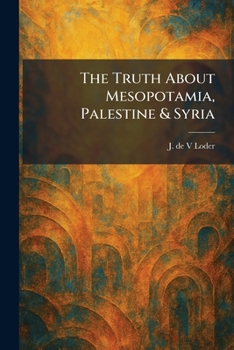
The Truth About Mesopotamia, Palestine & Syria

"The Truth About Mesopotamia, Palestine & Syria" provides a detailed and authoritative examination of the political and social transformations in the Middle East following the First World War. Written during the pivotal years of the early 1920s, J. de V. Loder offers a contemporary analysis of the collapse of the Ottoman Empire and the subsequent establishment of the League of Nations mandates. The work delves into the complexities of British and French administration in the region, addressing the burgeoning nationalist movements and the geopolitical shifts that reshaped the Levant and Mesopotamia.
The narrative explores the tensions between imperial interests and the local populations' aspirations for self-determination. By analyzing the diplomatic negotiations and ground-level realities of the time, Loder sheds light on the origins of the modern borders and political structures of Iraq, Palestine, and Syria. This volume serves as a significant historical record, offering insights into the early 20th-century policies that continue to influence international relations and regional stability. It is an essential resource for readers interested in the historical foundations of the modern Middle East and the legacy of the Great War.
This work has been selected by scholars as being culturally important, and is part of the knowledge base of civilization as we know it. This work was reproduced from the original artifact, and remains as true to the original work as possible. Therefore, you may see the original copyright references, library stamps (as most of these works have been housed in our most important libraries around the world), and other notations in the work.
This work is in the public domain in the United States of America, and possibly other nations. Within the United States, you may freely copy and distribute this work, as no entity (individual or corporate) has a copyright on the body of the work.
As a reproduction of a historical artifact, this work may contain missing or blurred pages, poor pictures, errant marks, etc. Scholars believe, and we concur, that this work is important enough to be preserved, reproduced, and made generally available to the public. We appreciate your support of the preservation process, and thank you for being an important part of keeping this knowledge alive and relevant.
Customer Reviews
ThriftBooks ® and the ThriftBooks ® logo are registered trademarks of Thrift Books Global, LLC
