


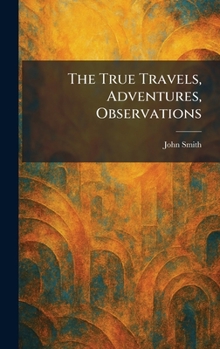
The True Travels, Adventures, Observations

"The True Travels, Adcentures, Observations" is a seminal autobiographical account by the legendary explorer and soldier, Captain John Smith. This expansive narrative chronicles Smith's extraordinary life across several continents, providing a firsthand look into the age of global exploration. From his early military campaigns in Eastern Europe against the Ottoman Empire to his pivotal role in the establishment of the Jamestown colony in North America, Smith's accounts offer a vivid depiction of cross-cultural encounters and the harsh realities of seventeenth-century life.
The work serves as a foundational text in both American history and travel literature. It details Smith's capture, his experiences as a slave in the Ottoman Empire, and his eventual escape and return to England. Furthermore, it provides critical insights into the geography and indigenous cultures of the New World as seen through the eyes of one of its most prominent early European figures. Readers will find a compelling mixture of adventure, geography, and personal observation that illustrates the complexities of a world in transition.
Written with the characteristic vigor of an adventurer, "The True Travels, Adcentures, Observations" remains an essential resource for understanding the colonial foundations of North America and the adventurous spirit of the early modern era. Its historical value lies not only in the events it records but in the perspective it offers on a pivotal moment in global history.
This work has been selected by scholars as being culturally important, and is part of the knowledge base of civilization as we know it. This work was reproduced from the original artifact, and remains as true to the original work as possible. Therefore, you may see the original copyright references, library stamps (as most of these works have been housed in our most important libraries around the world), and other notations in the work.
This work is in the public domain in the United States of America, and possibly other nations. Within the United States, you may freely copy and distribute this work, as no entity (individual or corporate) has a copyright on the body of the work.
As a reproduction of a historical artifact, this work may contain missing or blurred pages, poor pictures, errant marks, etc. Scholars believe, and we concur, that this work is important enough to be preserved, reproduced, and made generally available to the public. We appreciate your support of the preservation process, and thank you for being an important part of keeping this knowledge alive and relevant.
Customer Reviews
ThriftBooks ® and the ThriftBooks ® logo are registered trademarks of Thrift Books Global, LLC
