


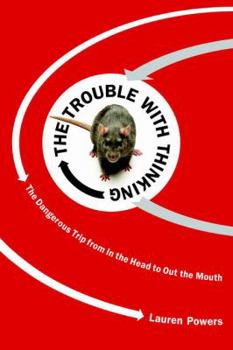
The Trouble With Thinking: The Dangerous Trip from in the Head to Out the Mouth

In this entertaining and thought-provoking account, Powers? demonstrates how our habits of thinking don't always help us.The Trouble with Thinkinginterweaves scientific research with an irreverent... This description may be from another edition of this product.
Format:Paperback
Language:English
ISBN:0595393969
ISBN13:9780595393961
Release Date:January 2006
Publisher:Iuniverse Inc
Length:124 Pages
Weight:2.50 lbs.
Dimensions:9.3" x 0.5" x 6.0"
Related Subjects
Happiness Personal Transformation Psychology Self Help Self-Help Self-Help & Psychology SuccessCustomer Reviews
3 ratings
A book to improve communication
Published by Thriftbooks.com User , 18 years ago
Reviewed by Leslie Granier for Reader Views (6/07) "The Trouble with Thinking: The Dangerous Trip from In the Head to Out the Mouth" is a self-help book that examines the role of communication, both verbal and nonverbal, and memory in how people form opinions and biases. This book has a broad appeal because it provides concrete examples of everyday situations with which most readers will be able to relate. It will be especially helpful for workgroups and committees which rely on interpersonal skills to accomplish tasks. It will also be beneficial to married people who are having trouble relating to their mates. Lauren Powers focuses on the processes people use to form opinions. She refers to this as the Rat Brain loop which involves automatic thinking rather than conscious thought. This loop consists of four distinct parts. First, the person selects information that supports what he believes. Next, the meaning of this information is defined. Then a label that is demeaning to one or more of the people involved is attached. Finally, an action or reaction is elicited either to defend one self, or prove someone else wrong. Rat Brain causes people to think negatively and expect the worst. This process of misinterpretation is what leads to hurt feelings. Rat Brain appears because gossip is always juicier than the truth; so, in order to eliminate it, people must learn to react with their heads instead of their hearts. Powers also states that the memories people retain are often flawed. People tend to remember some details, but fill in the rest of the information. Memory loss begins quickly after an event occurs. I thought the story of how several people can be in the same room and how no two of these people will see or experience the same things was very interesting. This is a rather alarming concept for me when it is applied to court cases or trials. Firsthand witness testimony is often used as a major part of the case, but if memory is that unreliable, perhaps new ways of obtaining evidence should be developed. Powers has a very effective style of keeping the readers' attention. The use of humorous anecdotes at the beginning of each chapter was a nice touch. It added some light-heartedness to a serious topic. She also included exercises to help change our methods for handling differences. She provides tips for how to talk to someone who has offended us so differences can be resolved. Everyone should read "The Trouble with Thinking" again and again. Rat Brain will never disappear, but it can be controlled through constant reminders of its presence. Changing our thought patterns can help us lead a happier and more productive life.
An educational, informative and humorous look at the inner workings of the mind that easy to underst
Published by Thriftbooks.com User , 19 years ago
Lauren Powers has achieved something difficult in this easy to understand and entertaining book. She has made the concepts of modern cognitive therapy and other modern research on the nature of emotion and cognition accessible to anyone without a background in psychology, biology or any other science. This very readable book is filled with entertaining stories that illustrate important points about what can go wrong between perceiving a situation and taking action. Namely, it looks at how we often end up operating on autopilot rather than making conscious choices. It also talks about how to break out of this cycle. The subtitle is a very good encapsulation of the subject matter -- the dangerous trip from in the head (thinking) to out the mouth (speaking/action)! Specifically, this books breaks down the communication process into four components: how we select information, assign meaning, attach a label and then take action. Various things can go wrong at any of these stages and Lauren takes a deep look at each of these areas and uses real life examples to illustrate what she means and how to overcome our unexamined assumptions, cognitive distortions, etc. I think this book is well suited to people who are looking for a light read that is both educational and entertaining. While it introduces a lot of important and sophisticated concepts, it does so in a way that engages the reader in a manner similar to good fiction. This title also condenses the most important topics from a variety of excellent resources such as Antonion Demasio, Daniel Goleman, William Glasser and other folks who are at the leading edge of their respective fields. Lauren gives you the most important conclusions of these people and talks about their practical application in daily life. I found that this book is best suited to people who do not do a lot of reading in this field, but would like a toolkit of ideas for enhancing their communication and becoming more aware of why they do what they do. For people that are therapists or psychologists, their may not be enough detail or they will have seen much of the content before in other places. Lastly, the book is well organized and it repeats important concepts in different ways. If you are new to this stuff, you will have a good understanding by the time you reach the end of the book and you will be likely to retain this understanding because of the way it was presented and the effective use of engaging stories. The rat brain metaphor didn't quite work for me, but it also didn't detract from the underlying message.
Brilliant!!
Published by Thriftbooks.com User , 19 years ago
Lauren Powers is an engaging and brilliant writer. I laughed out loud and learned so much. You must read this book!!!
Copyright © 2026 Thriftbooks.com Terms of Use
| Privacy Policy | Do Not
Sell/Share My Personal Information | Cookie Policy | Cookie Preferences | Accessibility Statement
ThriftBooks® and the ThriftBooks® logo are registered trademarks of Thrift Books Global, LLC
ThriftBooks® and the ThriftBooks® logo are registered trademarks of Thrift Books Global, LLC
