


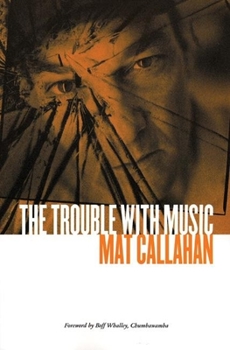
The Trouble with Music

Select Format
Select Condition 
Book Overview
Is capitalism killing music? This critical look at the music industry provides a timely and biting critique of music fabricated by the music industry for mass consumption while also exploring the alternatives. In this investigation he covers lots of ground, looking at all aspects of the industry, from internet downloading through radio air play to slumping record sales. As an author, musician and record producer Mat Callahan speaks with authority and experience.
Format:Paperback
Language:English
ISBN:1904859143
ISBN13:9781904859147
Release Date:February 2005
Publisher:AK Press
Length:200 Pages
Weight:0.96 lbs.
Dimensions:0.7" x 6.0" x 9.1"
Customer Reviews
5 ratings
Music makers, activists, and music theorists, please read this book!
Published by Thriftbooks.com User , 18 years ago
While I am not a musician (unless you count playing the air guitar, in which case, I totally rock!), I found this book both highly educational and fun. Providing an inspirational left libertarian anaylsis of the corporate music industry, Callahan insists that if music is in crisis (which it is), it's because humanity itself is in crisis. Rather than reflecting our collective experiences of political struggle, human suffering, and celebration, mass produced music has become like fast food, inundating the market but providing no real nourishment. From the plight of pirate radio stations to the digital downloading controversy to the labor battles of musicians, this book explores the myriad ways that art and politics intersect in our culture. Because the ruling-class fears the radical potential of music to transform the world, music has historically been the target of censors. As the blacklisting of musicians like The Weavers in the United States and the murdering of folksingers like Victor Jara during the Pinochet regime in Chile have proven, music is not a marginal issue for civil libertarians. Moreover, like land, like water, like DNA, music should belong to the commons to benefit all of humankind rather than being monopolized by a few corporations. As such, Callahan argues not only for a music of liberation, but for the liberation of music. Linking the erotic to the political, Callahan furthermore feels that we should root our music and our activism in our deepest feelings of interconnection, being alive, and being in love. The love he speaks about however is not the kind of shallow sentimentality bubble gum boy bands sing about, but the brave kind of love that energized the labor movement of the '30s and the anti-war and civil rights movements of the '60s. Though the corporate music industry oftentimes exploits sexuality for profit, it does not/can not allow sexuality to unify communities in pursuit of social justice. Because the power of carnival is connected to the slave drum and the power of political demonstrations, the ruling-class seeks to control communal gatherings that encourage the sharing of music, political ideas, and solidarity. Though activist musicians like David Rovics, Pamela Means, Mercedes Sosa, Michael Franti, Rage Against the Machine, Ryan Harvey, Sweet Honey In The Rock, Silvio Rodriguez, and Holly Near continue to make important music, sadly, very few individuals outside of the counterculture(s) even know that these musicians exist. As activists and artists, we need to popularize those forms of musical expression that empower us rather than just entertaining us, music like Nueva Cancion, anarcho-punk, and revolutionary hip-hop. By making participatory music that challenges injustice and creates a culture of peace, radical musicians are both the drumbeat and the heartbeat of our movements for social change.
A valuable contribution to music & politics...
Published by Thriftbooks.com User , 19 years ago
The "inherent problem with music criticism" (and art in general) is taken head-on in the foreword by Boff Whaley (Chumbawumba). He notes that on one hand, there's something he doesn't like about Bruce Springsteen - a "common man" - but on the other, "There are thousands of bands and musicians I do like whose cultural contradictions, stylistic failings, political ignorance and all the rest are gently eased to one side, just out of my sight, in a place where I can enjoy the music." This despite being "a sucker for context" and political meaning. (pg xv) Rather than become apathetic, the task at hand is to do the best possible, within the limitations of subjective trappings, in exploring the topic at hand. An insider to the business, Callahan explores this topic effectively, dealing with theoretical issues and incorporating empirical evidence into his argument. The scope ranges from the over-saturation of music product on the market to the day-to-day lifestyle of musicians; from corporate moneyed interests to the problem faced by the many poor starving artists. Callahan approaches the topic with an obvious social perspective - akin to some sort of anarchism - which frames his argument. Of course, if you already believe that music saturating the radio and television is predominately expressive of that which is tolerable by corporate interests - exceptions notwithstanding - then you'll find this a cogent exposition. As Noam Chomsky put it, would you expect to see a sitcom of a family living under the Mohawk Valley formula (1930s, employed by James Rand, president of Remington Rand; well documented and uncontroversial, however distasteful it may seem)? Yet propaganda as a form of manipulation to combat union organization was a very real problem for those trying to secure a decent life. Similarly, mainstream media outlets are no shortage of songs about romantic relationships, good times, loneliness, social isolation, money and socioeconomic status; in short, a pallet of emotional experience and even some tales of injustice. Yet the true voice of struggle against power and authority, concentrated in the hands of corporate and political institutions, ensures that that dissent will be kept to the margins. Callahan quotes Prince on the subject: "The consumers of the commercial products of the entertainment industry r only as cynical as the industry has deliberately made them, by dumbing down their products, by xploiting artists, by making profit-driven choices and decisions, and by providing their own kind with obscene compensations and legal impunity that r completely out of touch with the real world of ordinary people." (pg 194) The book concludes with a provocative discussion about intellectual property rights, downloading, and the public good. Callahan draws on original, time-honored sources of insight - like Thomas Jefferson, Adam Smith and Karl Marx - in considering the production and consumption of music from a sociological perspectiv
fight anti-music
Published by Thriftbooks.com User , 20 years ago
Mat Callahan's The Trouble With Music is a scathing look at the "music industry": capitalism's disastrous effects on music, the people who make music, the people who listen to it, and the entities that profit off of it. Callahan's argument is based on the distinction between what he calls authentic music and "anti-music." While there are many ways one might evaluate the idea of "authenticity" in music and other art, Callahan claims this is not simply a matter of taste. For Callahan, these two categories are discernable in fact: anti-music is music made in service to corporate "major" labels that are actually owned by large conglomerates and maintained by persons who care nothing about music, as opposed to authentic music which emerges organically from human communities themselves. The book tackles this theme from a variety of angles, with chapters dealing with music criticism, the history of radio (including college radio), the role of dance and performance, lyrical themes, and the notion of intellectual property rights. Callahan grounds his dead-on rants with references from philosophy, history, and art criticism, including thoughtful appropriations of Tolstoy's What Is Art?, Theordor Adorno, Mikhail Bakhtin, and Karl Marx. Two of the more insightful chapters deal with the absolute joke-of-a-debate about filesharing, and a scathing look at how capitalism uses "left-leaning" celebrity musicians (such as Bono) to give the appearance of political progressivism while leaving the entire capitalist system unchallenged. One weakness of the book is that Callahan focuses only on the corporate "major" labels while not really dealing with the independent music industry and how it at times tends to mimick the majors. As a musician involved in the indie music scene, a critique of "just how indie" the independent music system is would have been appreciated. Callahan's strength in looking at - and combating - "anti-music" is that he doesn't simply want to fight it because it frequently results in aesthetically "bad" music. Ultimately, what Callahan is after is an answer to the deeper question: "What kind of world produces such music?" In answering that question, he gives the reader near-mystical hints at his vision of what a world truly in love with music, the infinite, would look like: "What if the only people who made music were those who loved to do it? What if they only people who listened to music were those who loved to listen to it? What if MTV went off the air, the radios went silent and all that was left were people organizing their own concerts and playing the music they loved? What if the only recordings that were made were those musicians who had something important enough to say that it justified their own investment in it? What if the only way to find and hear this music was PAYING ATTENTION?!" [www.catholicanarchy.org]
I hope everyone involved in making music reads this
Published by Thriftbooks.com User , 20 years ago
Mat Callahan investigates the forces at work in the music of our time in a critical and reasonable manner, addressing the problems that have saddled us with listening (voluntarily and involuntarily) to corporate garbage (he calls it anti-music). His views are flexible, intelligent, and non-monolithic. His writing is clear. Every paragraph is thought provoking. He doesn't rant or polemicize as many drawing his conclusions would be tempted to do. There is a lot of substance here: this book is deep -without becoming academic or ponderous- and very readable -without becoming shallow and facile like most writing about popular music.
A very solid book on todays music in todays mordan world
Published by Thriftbooks.com User , 21 years ago
Theres so much covered here in this book. Mat besides just his expierences in the music world personally is a valuable insight. Yet, he also took in some significant research in mordern up rise of the music industry too. He goes back to how the radio was origionally was a tool for community and life and how internet was supposedly the that too but, we all know commercialism buys up and spoils it all....The one subject which the author admits is subjective matter. But, twas the most interesting was his theory on anti-music. More or less he's on the ball with this. Think about how when you're at the grocery store or in the mall or some lobby waiting for the doctor ect... You're forced to listen to whatever dribble. How much of it is really music. Look to the movies and american idol ect... Crap thats churned out to bought yet to be thrown away instantly. Surprisingly or perhaps i missed it is how the modern music industry is just like big tabacco. When you look at it the big 3 music labels more or less run the business just as so. Also, goes into good detail on how the reality of the "rock star" is getting more and more blurred as if they're mythical and unattainable guitar heros. Well, theres a lot covered in this book and finally someone put one out thats simple to read and easy to crossreference if you want seek out other facts and theories on music in todays cultral standpoint. I've already picked up an extra copy for a friend as a gift and given my copy away to another cause it's just that good of a book.
Copyright © 2026 Thriftbooks.com
Terms of Use | Privacy Policy | Do Not Sell/Share My Personal Information | Cookie Policy | Cookie Preferences | Accessibility Statement
ThriftBooks ® and the ThriftBooks ® logo are registered trademarks of Thrift Books Global, LLC
ThriftBooks ® and the ThriftBooks ® logo are registered trademarks of Thrift Books Global, LLC
