


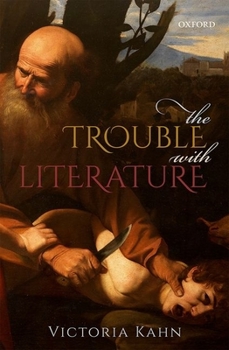
The Trouble with Literature
No Customer Reviews

This book, based on the Clarendon Lectures in English for 2017, argues that the literature of the English Reformation marks a turning point in Western thinking about literature and literariness. But instead of arguing that the Reformation fostered English literature, as scholars have often done, Victoria Kahn claims that literature helped undo the Reformation, with implications for both poetry and belief. Ultimately, literature in the Reformation is one vehicle by which religious belief was itself transformed into a human artifact, whether we understand this as a poetic artifact or a mental fiction. This transformation in turn helped produce the eighteenth-century discipline of aesthetics, with its emphasis on our experience of non-cognitive pleasure in the work of art, and the modern formalist definition of literature, according to which--in the words of one critic--'literature solves no problems and saves no souls.' This modern definition of literature, in short, has a history, this history is intertwined with the problem of belief, and by returning to the fraught years of the late sixteenth and seventeenth century in England, we can come to a new understanding of how the trouble with literature has shaped our discipline. The first lecture contrasts modern and early modern understandings of literature and literariness. The second and third lectures focus on Thomas Hobbes and John Milton. The fourth lecture treats the work of Immanuel Kant, Soren Kierkegaard, and J.M. Coetzee.
Format:Hardcover
Language:English
ISBN:0198808747
ISBN13:9780198808749
Release Date:May 2020
Publisher:Oxford University Press
Length:208 Pages
Weight:0.70 lbs.
Dimensions:0.7" x 5.1" x 7.9"
Customer Reviews
0 rating
Copyright © 2026 Thriftbooks.com Terms of Use
| Privacy Policy | Do Not
Sell/Share My Personal Information | Cookie Policy | Cookie Preferences | Accessibility Statement
ThriftBooks® and the ThriftBooks® logo are registered trademarks of Thrift Books Global, LLC
ThriftBooks® and the ThriftBooks® logo are registered trademarks of Thrift Books Global, LLC
