
Skip to content
Scan a barcode
Scan
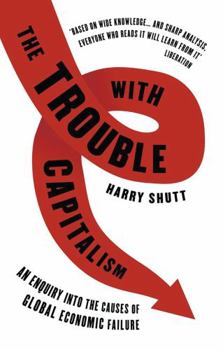
Paperback Trouble with Capitalism: An Enquiry Into the Causes of Global Economic Failure Book

ISBN: 1848134223

ISBN13: 9781848134225

Trouble with Capitalism: An Enquiry Into the Causes of Global Economic Failure

Select Format

Select Condition ThriftBooks Help Icon

Recommended

Format: Paperback

Condition: New

$40.72
50 Available
Ships within 2-3 days

Book Overview

The recent collapse of the banking system and instability in the financial markets has dramatically shaken confidence in the global economic order. Is the current variant of 'free market' capitalism really sustainable? The Trouble With Capitalism - originally written, with remarkable prescience, in 1998 - anticipates such a development and explains the underlying economic fragility it has revealed. Rather than being merely a temporary blip in the march of capitalism, Shutt argues forcefully that the on-going crisis has arisen as a result of fundamental economic problems, stemming from the growing redundancy of both labour and capital since the 1970s. In doing so, he exposes the sham of the laissez faire prospectus, showing that state power and capital are increasingly being used to prop up capital while pretending that the aim is to roll back the frontiers of the state.

The implications of the author's startling conclusion (re-examined in a new foreword) - that the maximisation of profit must cease to be the main basis for allocating resources - are profound.

Customer Reviews

3 ratings

Is Free Market Capitalism the Only Game in Town??

+++++ The objective of this book, by economist and economic consultant Harry Shutt, is "to expose the realities of the...evolution of the global capitalist economy, and thereby to dispel the illusions which lie behind the neo-laissez-faire prospectus [a policy that states the economy works best with no governmental regulation or control]." Shutt does not take random potshots at the capitalist system but instead uses a historical approach with regard to the origin of capitalism in order to identify problems with the present system. As well, this book "attempts to bring together different fields of economic analysis (such as the impact of technological change, the evolution of financial markets, and Third World development) which are all too often considered in isolation from each other." This book also "steps beyond the confines of economics to consider [other factors such as] the cultural, ethical, and geopolitical ramifications of...capitalist development." In other words, this book considers the human side of capitalistic economics and does not only concentrate on economic principles and market forces. Too often books on economics (especially basic economic books) concentrate only on economic principles without even considering the human element. The result is that everything appears well on a theoretical economic basis but the majority of people who have to survive in a particular economy are having difficulty. Before jumping into the main thrust of the book, there is an introduction that caught my eye immediately. Here, Shutt mentions three reasons as to why the claims that the capitalistic free market system is the best may not be true despite what "official propaganda" and rhetoric tells us. He ends his introduction with this startling statement: "As failure to resolve the world's profound economic distortions gives rise to more and more symptoms of social breakdown and civil strife in every continent, the need to focus wider public attention on their causes and effects has never been more pressing." Shutt's journey on the origin of capitalism takes the reader to such highlights as the Industrial Revolution, the span from the 1920's economic boom and the 1930's Depression, World War Two, the postwar years, and the Soviet collapse. It ends in the present. The majority of this book becomes an analysis of how bad things have become thanks to such things as capitalist profit maximizing; globalization; privatization; deregulation; leverage buyouts; hostile takeover mergers; monetarism (theory which holds that economic stability and growth result from maintaining a steady rate of growth in the supply of money); "creative" accounting; redundant excess capital; fraud; corruption; organized crime; and the biggest problem of them all -- sluggish economic growth. The last chapter of this book is the best. It reveals the author's profound main conclusion: the maximization of profit will cease to be the main basis of allocating re

Can capitalism be fixed?

This book has pierced the hubris of laizze-faire thought so common amongst the current economic pundits. It is a clear evaluation of the limits of capitalism and its failure in light of the human notion of an expanding economy. It should be read with an analytical attitude and should not be prejudged solely because of the title. It elucidates "the trouble with Capitalism" and why it will continue to spawn the normal up and down cycles. It presents clear examples of how political expediency, practiced by most OECD governments in their quest to appear as defenders of the public good, continues to play into the hands of private investment seeking contined increases in returns at the expense of real value. If you have ever wondered why taxes continue to rise, this book will explain how the public purse has become the corporate trough for ever increasing returns. He gives some interesting solutions of how the future could unfold if society can refocus its prioities and look to the "real" public good. A good read for any student of economic thought. The quote attributed to Marx that "the trouble with capitalism is that it eats its young" may come to mind after reading this book.

A challenge to contemporary laissez faire economists

Harry Shutt makes a strong case that private for-profit capitalism is nearing the end of its useful lifespan. He argues that capitalism's crisis is marked by an oversupply of capital desperately seeking investment opportunities in a world possessing a limited supply of secure, profit-producing activities. The author has written an unique and insightful economic history of the post-WW II world, tracing many contemporary problems back to their root causes and exposing official explanations as propaganda. For example, the privatization of state assets has been aggressively promoted principally because they provide new homes for investment dollars -- not necessarilly because the private sector can more efficiently run these enterprises (which in fact they often can not). Shutt suggests that the industrial economies have created an untenable situation for themselves. Public debt has been increased in order to prop up asset values (witness the Savings and Loan bank bail-out in the U.S. and other corporate welfare policies), making it difficult for governments to invest in either their own infrastructures or third world governments. This means that the world economy can not grow at a fast enough pace to satisfy the needs of private capital. Eventually, the oversupply of capital will lead to a crash in asset values.Events that have occurred after the book's publication suggest that the author was on the mark. The Internet stock investment mania and its subsequent collapse illustrates how desperately capital latches onto any opportunity that might promise above-average profits, however risky it may actually be. Shutt finishes the book with an outline of what the world might look like following a crash of the present system. The author suggests that an institution such as the European Union (or more precisely, an expanded and modified version of the E.U.) could be used to manage a more just and equitable system: namely one that balances the needs of labor, environment and capital, with primacy given to local, sustainable business enterprises that are fully accountable to the public.This is a highly readable and stimulating book. Anyone with an interest in contemporary political economy should enjoy it.
Copyright © 2025 Thriftbooks.com Terms of Use | Privacy Policy | Do Not Sell/Share My Personal Information | Cookie Policy | Cookie Preferences | Accessibility Statement
ThriftBooks ® and the ThriftBooks ® logo are registered trademarks of Thrift Books Global, LLC

GoDaddy Verified and Secured