


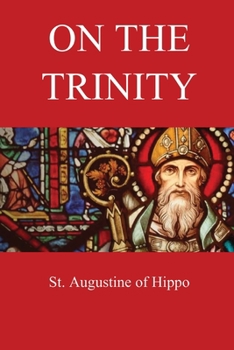
On the Trinity


Select Format
Select Condition 
Book Overview
On the Trinity is a Latin book written by Augustine of Hippo to discuss the Trinity in context of the logos. Although not as well known as some of his other works, some scholars have seen it as his masterpiece, of more doctrinal importance even than Confessions or The City of God.
Format:Paperback
Language:English
ISBN:1088091768
ISBN13:9781088091760
Release Date:May 2023
Publisher:Dalcassian Publishing Company
Length:328 Pages
Weight:1.00 lbs.
Dimensions:0.7" x 6.0" x 9.0"
Related Subjects
Faith Grace Salvation Sin Non-Fiction Apologetics Christian Books & Bibles Church History Philosophy ReligionCustomer Reviews
4 ratings
Essential reading for Christian thinkers
Published by Thriftbooks.com User , 18 years ago
St Augustine was, before Aquinas, the most subtle and brilliant intellect in the Western Church. While Augustine's influence has sometimes been debated and even criticised, most recognise that he was both an outstanding theologian and a highly original philosopher. The Trinity is one of the works of the later period of Augustine's life, after he had been consecrated as Bishop of Hippo. During this period Augustine spent most of his time and energy on pastoral and theological issues, including deep theological reflection on the scriptures and theology. The Trinity is Augustine's attempt to plumb the mystery of God, as revealed to Christians as the triune God of Father, Son and Holy Spirit. It contains some fifteen or so books in which Augustine attempts to develop a systematic theology of the Triune God based around scripture, as well as outlining a theological anthropology which discusses how the image of God exists in human beings, and how the economy of salvation is effected through Christ's atoning sacrifice on the cross and through the free acceptance of God's gift of salvation by the process of baptism and incorporation into the body of Christ, the Church. Augustine's text contains many profound and interesting theological insights which in themselves would become articles of dogma. Unfortunately, this tends to misrepresent Augustine, who was a very curious and inquiring thinker, who desired to understand God as much as was humanly possible. This book will be of most interest to theologians, but it will also interest philosophers and students of comparative religion, as well as those interested in Christian spirituality.
Doctor's advice
Published by Thriftbooks.com User , 20 years ago
St. Augustine's position as a Doctor of the Church is understandable, even after only reading parts of this terrific book! He really comes at a discussion of the Trinity in a logical fashion that appeals to hearts and experiences, not just minds! I'd definitely recommend it to anyone of a particularly cerebral bent looking to learn more about their faith from a Doctor of the Church! This isn't light bedside reading, and it won't seem as simple as, say, the wisdom shared by Therese of Lisieux. But for those looking to read and learn about the Trinity, this book offers a deep and rich look at a mystery of the faith that many of us today take for granted, from a time when many people didn't take it for granted!
Extremely informative
Published by Thriftbooks.com User , 20 years ago
Having written my senior thesis on St. Augustine's concept of the Trinity, I found Fr. Hill's edition to be a great resource in my research of the subject. His introduction to the treatise is a must-read, providing a solid overview of Trinitarian history, reviewing some of the early heresies and disputes, and introducing us to Augustine's predecessors. This introduction is invaluable for any who wish to understand De Trinitate in the context with which it was written, as it offers a defense against criticisms placed upon it by later theologians.
an essential classic for trinitarian theology
Published by Thriftbooks.com User , 25 years ago
There is much discussion in contemporary theology about the Trinity (e.g. Moltmann, LaCugna, Gunton, Pannenberg, Rahner, Barth). In order to appreciate the discussion intelligently, you ought to go back to the source of the Western model of the Trinity. One of Augustine's analogies for the Trinity is the Father the Lover, the Son the Beloved, and the Spirit as the Love. Quite a few theologians are critical of Augustine's emphasis on the unity of the Triune God (e.g. Moltmann, Pannenberg, LaCugna). It is worth reading this work just to put their work in perspective.This work is more than just an exposition of theology. Augustine has a long discussion of perception (memory, understanding and will), because he needs to give an account for how human seeing can fulfill its supernatural vocation to see God. Some of his discussion anticipates some of the concerns of the Enlightenment. E.g. if the representation I recall in my mind is from my memory, but is also shaped by my will, how do I know I have an accurate representation of reality?Another reason to get this work is that any attempt to tackle the Trinity ends up by a mini-systematics. In a fairly short space, a close read of the work will pay a mountain of dividends.In particular, Edmund Hill did an invaluable job editing and translating the work. The introductory notes, the endnotes, and the essays scattered throughout the work are worth the price of the book itself. I have gotten a lot more out of the work because of Hill's commentary (and they are not overly intrusive). Some of Hill's translations are a little bit too colloquial for my taste, but he wanted to write a dynamic translation. If you want a literal translation of this work, you can like in other places.All in all, this is one of the all-time classics in Christian theology.
Copyright © 2026 Thriftbooks.com Terms of Use
| Privacy Policy | Do Not
Sell/Share My Personal Information | Cookie Policy | Cookie Preferences | Accessibility Statement
ThriftBooks® and the ThriftBooks® logo are registered trademarks of Thrift Books Global, LLC
ThriftBooks® and the ThriftBooks® logo are registered trademarks of Thrift Books Global, LLC
