


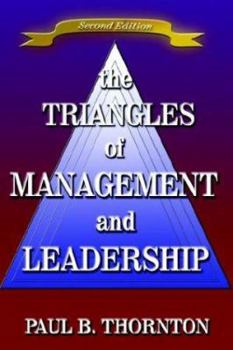
The Triangles of Management and Leadership

The Triangles of Management and Leadership presents a unique, cutting-edge approach to management and leadership, showing you what you need to lead and succeed. Each chapter includes first-hand... This description may be from another edition of this product.
Format:Paperback
Language:English
ISBN:1932303839
ISBN13:9781932303834
Release Date:January 2003
Publisher:Aeon Pub Inc
Length:192 Pages
Weight:0.80 lbs.
Dimensions:9.0" x 0.5" x 6.1"
Related Subjects
Business Business & Investing Economics Leadership Management Management & LeadershipCustomer Reviews
5 ratings
For anyone who aspires to improve their management skills
Published by Thriftbooks.com User , 22 years ago
In The Triangles Of Management And Leadership, author Paul B. Thorton draws upon his many years of experiences as a business consultant, executive coach, manager, and business administration professor to present a basic overview of what men and women need to be able to do or must know in order to successfully lead and succeed in today's highly competitive marketplace whether on a local, national, or global level. Through the use of "reader friendly" examples, Thorton covers all aspects of effective leadership. Of special note are the chapters on "The Big Three Management Styles"; "The ABCs of Motivation"; "The Managing Difficult People Triangle"; and "The Managing Your Career Triangle". Enhanced with a bibliography and an appendices on "Other Research", The Triangles Of Management And Leadership is confidently recommended and invaluable reading for anyone who aspires to improve their own management and leadership skills both in business and in life.
Solid, Simple and Effective Introduction
Published by Thriftbooks.com User , 22 years ago
Few writers have the gift of clarity. Even fewer management and leadership writers have that gift. Mr. Thornton explains important concepts and processes simply and effectively . . . as well as I have ever seen these subjects done. This book will be most valuable to those who are about to enter management or leadership, or having been practicing both for less than 10 years. I especially liked the way the book showed that everyone does some leading and some managing, and how they are different and related.Since The Fifth Discipline, business writers have been trying to capture the systems interactions that make business complex. When you ignore one of these interactions, major problems occur. For instance, give directions without listening first, and you may send someone onto the wrong route. By employing three-element interactions (triangles), Mr. Thornton beautifully gets across the importance of what to do, in what order and how each other element affects the results. I thought that this technique was the peculiar strength of this book, and one that I have not seen used as well as a communications device elsewhere. Here are a few examples: The Power Triangle (position, personal, expertise); The Listening Triangle (being curious, hearing, observing); The Foundation Triangle (mission, vision, values); and The Managing Conflicts Triangle (compete, compromise, collaborate). Here are some of the other triangles: Learning; possibilities; self-fulfilling prophecy; communications; process management; planning; problem-solving; and managing your career. There are 19 triangles in all, each of which has a chapter.The chapter structure is very easy to follow. First, the concept is explained in detail. Then the concept is summarized. Finally, there are two examples of applying the concept. Mr. Thornton is obviously well read, and draws on many of the best management thinkers and writers as his sources. He also has a number of fine examples in the book. Seeing that this is the second edition of the book, my suggestion is that in the third edition he should add more examples that do not involve consultants and those who teach leadership and management. I thought that the examples that used ordinary people were the most compelling. Also, some of the same gurus show up a little too often in the examples. The potential improvement would be to create some sort of graphic that would tie the triangles together into some conceptual framework how they relate to each other.After you finish this fine book, think about how you can help others understand the process of making progress in what you do. What are the three most important elements? How are they related to each other? Where should a person start? With whom should they interact? What should happen? What is a good summary of the concept? What are two good examples of applying the concept?
Highly Recommended - Especially for New or Aspiring Managers
Published by Thriftbooks.com User , 22 years ago
In my review of another of Paul B. Thornton's excellent books ("Be the Leader: Make the Difference"), I noted that it is rare to find a business author who not only gets what leadership and management is all about but who also is capable of conveying actionable advice. Mr. Thornton is a much-welcomed exception. An accomplished consultant, Mr. Thornton knows how the best managers think and lead - how they accomplish results. More importantly, he knows how to distill and communicate powerful yet practical, real-world advice. "The Triangles of Management and Leadership" is highly recommended, particularly for new or aspiring managers who are struggling to get their minds around their new roles and deliver genuine results. Taking on a management role is often as scary as it is exhilarating. Few schools or organizations truly prepare you. This book - a concise, compelling primer - will be a big help to you and your career.
The Solid Geometry of Organizational Leadership
Published by Thriftbooks.com User , 23 years ago
There are several excellent books about leadership which have been written primarily for the relatively inexperienced executive and this is one of the best, as is Thornton's subsequently published Be The Leader, Make the Difference. I do not damn with faint praise when sharing that observation. Over the years, working with young executives to accelerate the development of their leadership and management skills, I soon became convinced that they lacked sufficient real-world business experience and a consequent frame-of-reference. Thornton provides the latter in this book and in Be The Leader, Make the Difference.Wisely, he selects a core concept (the triangle) which enables him to introduce and then discuss various dimensions of leadership. For example, its "foundation" which consists of mission, vision, values; what he calls "The Three Cs" (challenging people, building their self-confidence, and coaching them); three different management styles (directing, discussing, and delegating); and effective communications, without which no leadership initiatives can possibly succeed. Thornton devotes a chapter to each of several basic "Triangles": Communications, Power, Finance, and Leading Teams. The challentge for each person is to keep the three components of each triangle in an appropriate balance. At a time when change is the only constant, that is indeed a formidable challenge. Although Thornton did not write this book primarily for senior-level executives, even they can benefit substantially from the book's simplicity and his ability to connect the dots. If they read this book, they will improve their skills for mentoring and coaching those for whom they are directly responsible. The material which Thornton provides is relevant to the leadership needs of any organization, regardless of size or nature. Granted, most of those involved have responsibility but no authority. Nonetheless, Thornton's observations and suggestions can inform and direct their individual initiatives. Ask these questions of any supervisor: How many of your people volunteer for difficult tasks? How many of them are willing to go "the extra mile"? How many of them are seriously committed to doing more, doing it better, and in less time? In effect, how many of them "get it"? As previously indicated, college and university graduates preparing for a career in business as well as others only recently embarked on one will derive the greatest benefit from this book. I presume to suggest that one of their most important goals is to become indispensable to organizations which employ and to those who supervise them. How? The answer to that question is provided in this book.Those who share my high regard for this book are urged to check out Joan Magretta's What Management Is as well as Jeffrey J. Fox's How to Become a Great Boss, Rex P. Gatto's The Smart Manager's F.A.Q. Guide, Steven Silbiger's The Ten Day M.B.A, Milo Sobel's. The 12-Hour MBA, Robert F. Bruner et al's The Portable MBA,
weLEAD Book Review by the Editor of leadingtoday.org
Published by Thriftbooks.com User , 23 years ago
The Triangles of Management and Leadership is an easy to read book that is hard to put down. Author Paul Thorton has a direct way of getting right to the core of an issue (without the fluff). Composed of 14 short chapters and 120 pages long, you may be able to read this publication in one or two sittings. Thornton uses his years of consulting and workshop experience to get to the "nitty-gritty" of leadership basics. After a brief introduction he begins a "step by step" guide to better leadership awareness. Chapter 1 deals with a sound leadership foundation, which includes mission, vision and values. In chapter 2 he introduces what he calls the "Three C's of Leadership" which are the three things leaders should do! These are 1) they challenge people; 2) build people's confidence and 3) they coach people. With this early foundation entrenched within the book, the following chapters begin to build the core message.The rest of The Triangles of Management and Leadership discuss management styles, the Power Triangle, planning, decision-making, managing conflict, motivation, feedback, controls, the Finance Triangle, dealing with difficult people and managing change. The author likes to use 3's to connect major points or concepts as in the 3-points of a triangle. Each chapter is followed by a section called, "Applying the Concept" in which other organizational leaders comment on the major principles of the preceding chapter.If you are new to the subject of leadership, or like to read information in an easy to read style, The Triangles of Management and Leadership is a valuable resource. It is a sound primer for those discovering the need for leadership and change.
Copyright © 2026 Thriftbooks.com Terms of Use
| Privacy Policy | Do Not
Sell/Share My Personal Information | Cookie Policy | Cookie Preferences | Accessibility Statement
ThriftBooks® and the ThriftBooks® logo are registered trademarks of Thrift Books Global, LLC
ThriftBooks® and the ThriftBooks® logo are registered trademarks of Thrift Books Global, LLC
