


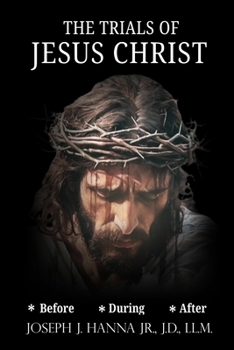
The Trials of Jesus Christ
No Customer Reviews

The trials of Jesus Christ by Hanna offers an insightful and unique analysis of one of the most, if not the most, pivotal trials in history. Hanna examines the two trials of Jesus, first under the Hebrew law and then under Roman law, both of which offered protection of the rights of the innocent, especially Hebrew law, which had more safeguards than normal by any standard for an accused.
The nooks and crannies of the law are carefully examined and may surprise the reader how this man could ever have been found guilty of treason or be crucified, and, as Cicero said, it was the worst form of punishment. The Romans, who widely applied crucifixion to others, prohibited it as a form of punishment for their own citizens. The book covers in capsule form other famous historic trials throughout the world that were also wrongly decided, including, for example, the trial of Socrates. Hanna starts not with the theological and thus does not refer to him as 'Jesus' (meaning God saves) as such but only refers to him as the man from Galilee or the Galilean. The more you study the man according to the author, the more you see more than just a man. The facts regarding this person, obtained primarily from the four Gospels, are highly credible as compared to other famous and accepted writings of antiquity, including Homer's Iliad. By comparison, the Gospels were reduced to writing sooner in time and by more authors than other writings of antiquity. There is a chapter on how common crucifixion was in the world and what causes death from that form of punishment.The author's goal was to give insight and clarity to that which is frequently viewed as opaque, as well as to challenge the assumed, or taken for granted, mindset. Throughout the author challenges that which is often deemed as a given, including even the theological, to spark insight, reminiscent of the old saying of G.S. Patton in capsule form, if everyone is thinking the same, no one is thinking. Finally, the epilogue summarizes some of the accomplishments of the Galilean's short time on this planet, and that the world is now forever changed by his return and the indelible footprints he left behind. The book leaves with a brief yet insightful poem by Hanna-a quite reflection of the Galilean's presence, capturing the timeless imprint he left on time.
Format:Paperback
Language:English
ISBN:B0F43T76K5
ISBN13:9798316670192
Release Date:April 2025
Publisher:Independently Published
Length:193 Pages
Weight:0.59 lbs.
Dimensions:0.4" x 6.0" x 9.0"
Customer Reviews
0 rating
Copyright © 2026 Thriftbooks.com
Terms of Use | Privacy Policy | Do Not Sell/Share My Personal Information | Cookie Notice | Cookie Preferences | Accessibility Statement
ThriftBooks ® and the ThriftBooks ® logo are registered trademarks of Thrift Books Global, LLC
ThriftBooks ® and the ThriftBooks ® logo are registered trademarks of Thrift Books Global, LLC
