


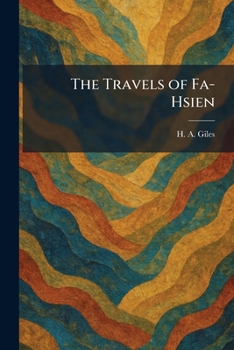
The Travels of Fa-Hsien

"The Travels of Fa-Hsien" is a seminal travelogue documenting the remarkable journey of the Chinese Buddhist monk Faxian (Fa-Hsien) as he trekked through Central Asia and India between 399 and 414 CE. Seeking authentic Buddhist scriptures and sacred sites, Faxian's arduous pilgrimage took him across the Gobi Desert, through the rugged Hindu Kush, and into the heart of the Indian subcontinent during the height of the Gupta Empire. This account serves as one of the most significant primary sources regarding the state of Buddhism, regional customs, and the geographical landscape of the early fifth century.
Translated and annotated by the distinguished sinologist H. A. Giles, this volume provides a vivid window into ancient civilizations and the diffusion of religious thought across borders. From detailed descriptions of holy sites in Lumbini and Bodh Gaya to observations on the social and political structures of the regions he visited, "The Travels of Fa-Hsien" remains an essential text for historians, scholars of religion, and those fascinated by the history of world exploration. It captures a pivotal moment when the Silk Road served as a vital artery for the exchange of spiritual and cultural ideas across the Asian continent.
This work has been selected by scholars as being culturally important, and is part of the knowledge base of civilization as we know it. This work was reproduced from the original artifact, and remains as true to the original work as possible. Therefore, you may see the original copyright references, library stamps (as most of these works have been housed in our most important libraries around the world), and other notations in the work.
This work is in the public domain in the United States of America, and possibly other nations. Within the United States, you may freely copy and distribute this work, as no entity (individual or corporate) has a copyright on the body of the work.
As a reproduction of a historical artifact, this work may contain missing or blurred pages, poor pictures, errant marks, etc. Scholars believe, and we concur, that this work is important enough to be preserved, reproduced, and made generally available to the public. We appreciate your support of the preservation process, and thank you for being an important part of keeping this knowledge alive and relevant.
Customer Reviews
ThriftBooks ® and the ThriftBooks ® logo are registered trademarks of Thrift Books Global, LLC
