


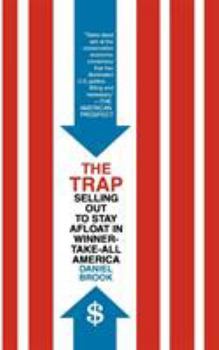
The Trap: Selling Out to Stay Afloat in Winner-Take-All America

Select Format
Select Condition 
Book Overview
"Takes dead aim at the conservative economic consensus that has dominated U.S. politics . . . Biting and necessary."--The American Prospect
In this witty and revealing polemic, journalist Daniel Brook's The Trap argues that the exploding income gap--a product of the conservative ascendance--is systematically dismantling the American dream, as debt-laden, well-educated young people are torn between their passions and the pressure to earn six-figure incomes. Rising education, housing, and health-care costs have made it virtually impossible for all but the corporate elite to enjoy what were once considered middle-class comforts. Thousands are afflicted with a wrenching choice: take up residence on America's financial and social margins or sell out. From the activist who works to give others a living wage but isn't paid one himself, to the universal health-care advocate who becomes a management consultant for Big Pharma, Brook presents a damning indictment of the economic and political landscape that traps young Americans.Format:Paperback
Language:English
ISBN:0805088016
ISBN13:9780805088014
Release Date:April 2008
Publisher:Holt Paperbacks
Length:288 Pages
Weight:0.60 lbs.
Dimensions:0.7" x 4.9" x 8.0"
Customer Reviews
5 ratings
The Elusive American Dream
Published by Thriftbooks.com User , 18 years ago
It is evident that a number of these reviewers have not read the book. The Trap is not about the selfish rants of idealistic recent college grads seeking a life of starving activism. It is about a pervasive crisis facing America, where it is becoming ever harder to live a comfortable middle-class lifestyle and pursue a meaningful career, even after graduating from a top-class college and holding a steady professional job. The book begins discussing a national PR director who took a job she doesn't enjoy in order to make enough money just to raise a family, "feel comfortable and have a sense of security." Chapter one profiles a computer programmer with a six-figure income who qualified for affordable housing in the town where he works. We also meet a teacher who, like many, can no longer afford to live in his own school district. Chapter two features a "master's degree-toting professional married to a Harvard-educated lawyer" in Washington D.C. who is worried about how she will afford to have a house and raise a family in the nation's hyper-gentrified capital. Born in Denmark she "grew up thinking that part of social justice is you can...afford some pretty basic things like decent schooling." In Chapter five we meet an aspiring tech industry entrepreneur in California, a government-hands-off libertarian, who is finding the path of starting his own business (the bread an butter of a free-market economy) almost impossible because of the high costs of entry including prohibitively expensive health insurance. The Trap also discusses lawyers and investment bankers, many of whom hoped to do more productive things with their lives, finding no other way to raise a family and pay off their colossal college loans than to join a corporate firm. There they work as essentially glorified secretaries doing menial tasks, working every waking hour in a job they hate, unable to enjoy their lives. The Trap explains, with substantive data, that today's struggles of all but the wealthy is a pervasive problem. Today's America makes entrepreneurship ever more difficult, and forces the nation's best and brightest into a select few professions where their skills, intellect and creativity are barely put to use. But it was not always this way, The Trap explains. Our current crisis is the result of generations of new tax policy, reducing the burden of the wealthy, and putting greater and greater burden upon the middle class. College tuition, healthcare, home prices and other basic expenses have risen exponentially, while middle-class incomes have been simultaneously falling. The Trap also discusses how this crisis does not just affect the middle class. Understanding the nature of the crisis raises critical concerns about how we can even begin to think that America can provide opportunity for those born into poverty if those privileged enough to attain a good education and professional career have trouble making ends meet. After reading The Trap, it becomes clear that
Our Middle Class has shot itself in the foot.
Published by Thriftbooks.com User , 18 years ago
What some reviewers have missed is the main point of The Trap; It should be possible for a salary to cover a comfortable lifestyle, medical coverage, education and security in old age. Now, thanks to the corporate takeover of our society (unlike other first world societies) we are loosing ground faster than we can recover it. Our middle class has been under persistent siege and has been flattened. Our children face a bleak future while too many Americans have been blinded by rightwing rhetoric about American individualism. Americans were community based barn-builders. Get a job? Where? All our jobs have been sold to the lowest bidder overseas.
Resist the propaganda
Published by Thriftbooks.com User , 18 years ago
There seems to be quite a negative marketing campaign against this book. If you read through the majority bad reviews, you see they're all on the same theme, that the author should grow up and face reality, and some are word-for-word duplicates under different reviewer names. I wonder why conservatives are afraid of ideas.
Better to have a permanent income than to be fascinating...
Published by Thriftbooks.com User , 18 years ago
So said Oscar Wilde and such is the moral of this book. In many ways, its touching - there are still people who'd like to teach kids, care for the sick or probe the secrets of the universe. But the burgeoning corporate elite with their astronomical salaries are driving the price of quality education, housing and healthcare sky high. So indulge yourself helping humanity and your kids will be lucky to afford community college. Welcome to a system where the best minds of our generation are trawling the tax code for loopholes, while we import math teachers from India. But - I hear you cry - surely day-traders benefit society too, filling the supermarket shelves with inexpensive paper doilies and fat-free lard, 'lobbying' politicians and betting on Pork Belly futures? Brook wouldn't deny it - his point is that the pay disparity is hurting everybody else. Brook's book is punchy and witty and uncomfortable and validating. His ideas for restoring the balance don't require a Marxist revolution. Read it and send it anonymously to a friend. Everybody will recognize a part of their own history in this book.
Great Opening Volley In A Debate That's Not Being Had
Published by Thriftbooks.com User , 18 years ago
This book is a great counter-intuitive look at how growing income disparity in the United States is hurting all of us, not just those trying to make ends meet with minimum wage. And it's not just 20-something independent filmmakers who are now struggling to pay the rent (although Brook does profile plenty of them) it's the district attorney who stops putting criminals behind bars to work in a corporate law firm to make ends meet. Teachers who can't even afford to buy a home in the city they teach in. Investment bankers, corporate attorneys and software engineers are all vital to the economy, but that doesn't mean they should be the only people who can afford to pay off their college loans, buy a house and (gasp!) maybe let one of the parents stay home and raise the kids. With the world we live in today, I for one want the people who commit their lives to community service or who work for the government--analyzing terrorist threats, tracking down tax cheats and making sure the medicine and food (and toothpaste) we consume aren't tainted--are the best qualified, best educated people available, not just those born rich or altruistic enough to take a cut in pay for work they think is important. With a mix of economics, sociology and anecdotal reporting, Brook does a great job showing how the skyrocketing costs of health care, education and housing, combined with (and caused by) the shift in the tax burden from the wealthy to the middle-class, is hurting us all. President Bush says that community service should replace big government intervention; that's fine, but as Brook shows, America's economy is making it increasingy hard for people to even do that.
Copyright © 2025 Thriftbooks.com
Terms of Use | Privacy Policy | Do Not Sell/Share My Personal Information | Cookie Policy | Cookie Preferences | Accessibility Statement
ThriftBooks ® and the ThriftBooks ® logo are registered trademarks of Thrift Books Global, LLC
ThriftBooks ® and the ThriftBooks ® logo are registered trademarks of Thrift Books Global, LLC
