


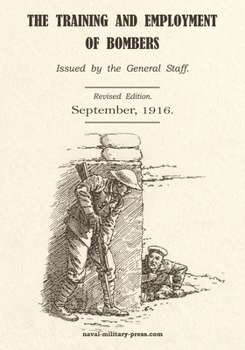
The Training and Employment of Bombers
No Customer Reviews

Select Format
Select Condition 
Book Overview
Reprinted from the revised British edition of September 1916, this manual outlines the principles governing the use of hand and rifle grenades in trench warfare. It covers training, organisation, offensive and defensive employment, safety measures, and the characteristics of British and German grenade types. The text is supported by line drawings and photographic plates illustrating proper throwing technique. By 1916, grenades had become indispensable in trench combat, evolving from improvised "jam-tin" and "hairbrush" designs into standardised weapons essential for clearing trenches and dugouts. Rifle grenades extended striking range beyond that achievable by hand. Specialised "bombing parties" emerged as key assault elements, tasked with clearing trenches systematically and driving defenders from cover-particularly valuable in conditions where small arms frequently malfunctioned. The manual details the tactical employment of grenadiers, emphasising that grenades were primarily for close-quarters trench fighting rather than open-ground engagements. It specifies command responsibilities, the organisation of bombing squads, supply arrangements, equipment, training requirements, and the appropriate integration of rifle and bayonet techniques when manoeuvring around trench traverses. Originally War Time printed by Harrison & Sons, photographic and engraved illustrations fall short of modern printing and type standards. In printing in facsimile from the original, imperfections and lightness of type are inevitably reproduced in this reprint.
Format:Paperback
Language:English
ISBN:1474542220
ISBN13:9781474542227
Release Date:March 2026
Publisher:Naval & Military Press
Length:138 Pages
Weight:0.56 lbs.
Dimensions:0.3" x 7.0" x 10.0"
Related Subjects
HistoryCustomer Reviews
0 rating
Copyright © 2026 Thriftbooks.com
Terms of Use | Privacy Policy | Do Not Sell/Share My Personal Information | Cookie Notice | Cookie Preferences | Accessibility Statement
ThriftBooks ® and the ThriftBooks ® logo are registered trademarks of Thrift Books Global, LLC
ThriftBooks ® and the ThriftBooks ® logo are registered trademarks of Thrift Books Global, LLC
