


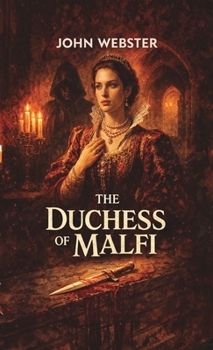
The Duchess of Malfi


Select Format
Select Condition 
Book Overview
A dark and gripping tale of power, corruption, and forbidden love. In The Duchess of Malfi, John Webster crafts a tragic drama centered on a widowed duchess who defies her controlling brothers by choosing love on her own terms. Her secret marriage sets off a chain of betrayal, madness, and ruthless revenge. Rich in poetic language and intense emotion, Webster's play explores themes of authority, morality, and the consequences of defying societal norms. Its haunting atmosphere and complex characters make it one of the greatest tragedies of English literature. Powerful and unforgettable, The Duchess of Malfi continues to captivate readers with its timeless exploration of human ambition, cruelty, and resilience.
Format:Hardcover
Language:English
ISBN:9378642748
ISBN13:9789378642746
Release Date:April 2026
Publisher:Kalamos Literary Services Llp
Length:118 Pages
Weight:0.63 lbs.
Dimensions:0.4" x 5.5" x 8.5"
Customer Reviews
6 ratings
“Cover her face; mine eyes dazzle: she died young.” - John Webster
Published by bernie4444 , 5 months ago
This was originally published as “The Tragedy of the Duchess of Malfy.”
Before you actually get to the play, do not overlook this fairly good introduction, including information on the author, early performances of Webster’s plays, the source of the play, Webster’s tragedy of the Duchess of Malfi, a note on the text, and acknowledgments.
It is good to know the source of the “cover her face” line in context. You might even have a new favorite writer.
Many people find out about this play through college courses. I came across this because of a quote from the play in Agatha Christie’s “Sleeping Murder.” Then I ran across this again as “Cover Her Face” by P. D. James. Then it started turning up everywhere, even “Queen of the D-a-m-n-e-d” by Anne Rice.
annotations
Published by Thriftbooks.com User , 16 years ago
I have little to say. This is a very great play--as great as many Shakerspearean tragedies. Why is there no thoroughly annotated texrt of it??
John Webster's "Romeo and Juliet"
Published by Thriftbooks.com User , 20 years ago
John Webster will probably never be as popular as William Shakespeare, Charles Dickens, or even Cliff Marlowe. Nevertheless, his writing is quite impressive. His plays came out about the time Shakespeare was putting out his final plays. As the play begins, we meet Bosola. While he is a murderer, he offers several intersting passages, and he is not quite a 2d villain. Bosola expresses his dislike for Duke Ferdinand and his brother the Cardinal. This opinion is shared by the Duchess's eventual husband Antonio. This allows Webster to prepare the villains of this story. The wicked Ferdinand expresses his wish for his sister (the Duchess) not to marry. Eventually, we will learn that he wants control over her estates. (How unheard of! Especially today!) He asks Bosola to spy on the Duchess. Bosola is a bit hesitant, but he proceeds. Well, the Duchess against her wicked brother's request marries Antonio secretly. Some time passes, and Bosola suspects that the Duchess is pregnant. While Antonio suspects the foul play of Bosola, he is basically a loving, but not so able man. Ferdinand of course finds out that his request has been disregarded. Interestingly, the cardinal comes off a little better when his cautious side contrasts with Ferdinand's rages. Onto Act 3. The Duchess and Antonio now have children. While Ferdinand knows the Duchess has married, he does NOT know Antonio is the husband. The poor Duchess makes the mistake of appealing to Bosola for help, and of course all is found out. Antonio is banished to Ancona. The parting between Antonio and the Duchess is quite sad. But all is not lost. Antonio flees to Milan and they may still be together. Sadly, hope disappears as the Duchess is arrested. Ferdinand orders Bosola to murder her, and while Bosola does hesitate, he performs the cruel murder of the Duchess. It is interesting that Bosola's evil deeds are often accompanied by hesitation and regret, as well as some interesting passages on the harsh truths of the human condition. But Webster does not stop here. Ferdinand's cruelty gives way to insanity and he taunts Bosola for carrying out his orders. Onto the final act. Poor Antonio (not knowing his wife is dead) has heard of Ferdinand's insanity. He thinks perhaps he can reconcile with the Cardinal. Soon we see that the cardinal is not quite an accomplished psychopath. With Ferdinand gone, he sinks further and further into panic trying to cover the bloody mess. In a well done scene, fragments of Antonio's echo foreshadow his downfall. Bosola accidentally kills Antonio and is filled with regret. The final scene begins with the cardinal giving a passage on fear of damnation. In a brutal massacre, Bosola, Ferdinand, and the Cardinal all die. The play ends with a restoration to order by the son of Antonio and the Duchess, but like Shakespeare's "King Lear," it doesn't take away the sadness of the play. Overall, it's a good play that combines an interesting variety of villains, romance, tragedy, suspens
A superb play
Published by Thriftbooks.com User , 25 years ago
Of the "popular" editions of this play that by John Russell Brown (Revels Student Editions) and Elizabeth Brennan (New Mermaids) are both useful, though it must be said that no edition as yet does adequate justice to Webster's compexity - notably his presentation of Ferdinand. The play is both a tour de force and profoundly searching. It is perhaps the first major feminist play in England, with the Duchess presented as an outstandingly noble even if fallible character, the victim of her two evil "partriarchal" brothers. Of these, her twin brother Ferdinand is among the most intelligently conceived characters to appear on the Jacobean stage. Unknowingly (i.e. in his "unconscious") he is incestuously in love with his sister. Unable to cope with this "taboo" feeling, he tries to "repress" it unsuccessfully, and finally his ... "libido" comes to express itself in a violent wish to destroy her if he cannot ... own her, and he ends up believing himself to be a wolf, attempting to dig up her grave after he has had her killed. Obviously, then, this is a very Freudian work - anticipating Freud's insights brilliantly by some four centuries, and without lapsing into Freud's extravagantly improbable claims about such matters as the Oedipus complex. It is the working of the unconcious, as a reservoir of what we do not understand and cannot control, which is quite central in this play, and Ferdinand's ... confusion is potently contrasted with his sister's openminded, acknowledged and generous ... health. An outstanding play, recommended as among the best of its time (comparable in quality and interest to e.g. *Othello* or *The Changeling*). - Joost Daalder, Professor of English, Flinders University, South Australia
Bloody, Gory, and Beautiful
Published by Thriftbooks.com User , 25 years ago
I do not feel Webster's "Duchess of Malfi" quite matches his "The White Devil." Nevertheless, it is still an excellent play. Only Webster could combine this much violence and beauty so well! Webster starts the play well when Antonio and Delio make comments on questionable characters. (Bosola and the Cardinal) Bosola is drawn well as the hired hand reluctant to join the demonic Ferdinand. 2.5 is captivating when Ferdinand explodes with fury upon discovering that the Duchess has married. The cardinal shows an interesting foil to Ferdinand when he tries to encourage caution. The fury exchanged between Ferdinand and the Duchess in 3.2 is memorable. Bosola offers a striking passage on politicians in 3.2. The tragic ceremony in 3.4 is sorrowful and yet beautiful. The parting of Antonio and the Duchess in 3.5 is very lamentable. 4.1 allows us to see that Ferdinand is not only evil, but demented as well. This paves the way for his final insanity. Bosola's hesitation to carry out the murder is well constructed. Ferdinand's final torture of the Duchess reminds us that he is not simply cruel, but psychotic as well. The Duchess is memorable when she faces her death with dignity. Webster DOES NOT stop here! Ferdinand actually taunts the hired killer and this paves the way for the final act. 5.3 is a scene that not even Marlowe or Shakespeare ever used. Fragments of Antonio's own echo foreshadow his death. Bosola's accidental murder of Antonio and his remorse pave the way for the final massacre! Even here, Webster keeps his efforts up. The cardinal's passage on fear of damnation keeps us in chills. Bosola's death and passage of remorse is a fitting end for this excellent work. My only complaint about this play is that the Cardinal could have been more complex.
A Literary Rulebreaker
Published by Thriftbooks.com User , 25 years ago
It quite simply isn't allowed! John Webster has written a play that takes all of the conventions of the Elizabethan and Jacobean tragedy, and then promptly dispenses with them. For this reason alone, it is worth reading The Duchess of Malfi - simply to see a warped formula that works exceptionally well. The play is slightly marred by Webster's wooden stage craft, but thankfully the originality of the story compensates for some stilted dialogue and awkward devices. For its time, Malfi was a sensational play - truly gruesome and bloody, with its special effects making it a Jacobean Hollywood Blockbuster.The characters are perhaps the greatest success of this play. Webster's Ferdinand is vile, his Duchess is fiesty, yet at times she commits acts that condemn her to not being dubbed a "heroine", such as her fake pilgrimage. Antonio, the principle male "good guy" is so outrageously stupid that one has to hate him for being wetter than a Thomas Hardy novel. In fact, the microcosm of the play is almost without virtue, save for Pescara (an interesting play on 'piscari' - the Latin for fish, the Christian symbol). Finally, the play pivots on the role of Bosola, who is neither anti-hero, villain, hero or anything else for that matter. He is a fabulous and intelligent malcontent: the Macciavel personified.Ultimately, if you are bored of reading the same formula within a tragedy, pick up the Duchess of Malfi and blow off the dust from the front cover. It is an often overlooked play, though its author has written a piece of theatre that is so strange and so difficult to perform that it is still largely snubbed by theatre companies today. By destroying the conventions of the tragedy to the extent that the end result arguably isn't a tragic play at all, Webster has written a play that is as important to the development of the modern tragedy as those which rigidly stick to the formulae.
Copyright © 2026 Thriftbooks.com
Terms of Use | Privacy Policy | Do Not Sell/Share My Personal Information | Cookie Notice | Cookie Preferences | Accessibility Statement
ThriftBooks ® and the ThriftBooks ® logo are registered trademarks of Thrift Books Global, LLC
ThriftBooks ® and the ThriftBooks ® logo are registered trademarks of Thrift Books Global, LLC
