


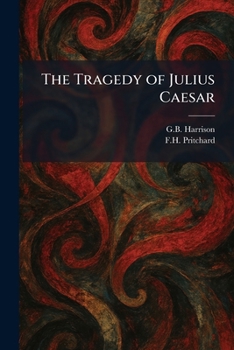
The Tragedy of Julius Caesar

Select Format
Select Condition 
Book Overview
"The Tragedy of Julius Caesar" is a powerful exploration of political power, honor, and the moral complexities of leadership. Set during the final days of the Roman Republic, the play follows the conspiracy to assassinate the ambitious Julius Caesar, whose rising influence threatens the traditional structures of Roman governance. Through its depiction of the tension between private friendship and public duty, the work provides a deep psychological study of Brutus, a man torn between his love for Caesar and his devotion to the Republic.
Renowned for its masterful rhetoric and iconic speeches, including Mark Antony's stirring funeral oration, the drama examines the volatility of the masses and the unintended consequences of political violence. Shakespeare's portrayal of the shifting tides of loyalty and the inevitable descent into civil war remains a cornerstone of the Western literary canon. This work continues to be celebrated for its sharp insights into human nature and the ethics of political action, offering a timeless reflection on the cost of ambition and the fragility of democracy.
This work has been selected by scholars as being culturally important, and is part of the knowledge base of civilization as we know it. This work was reproduced from the original artifact, and remains as true to the original work as possible. Therefore, you may see the original copyright references, library stamps (as most of these works have been housed in our most important libraries around the world), and other notations in the work.
This work is in the public domain in the United States of America, and possibly other nations. Within the United States, you may freely copy and distribute this work, as no entity (individual or corporate) has a copyright on the body of the work.
As a reproduction of a historical artifact, this work may contain missing or blurred pages, poor pictures, errant marks, etc. Scholars believe, and we concur, that this work is important enough to be preserved, reproduced, and made generally available to the public. We appreciate your support of the preservation process, and thank you for being an important part of keeping this knowledge alive and relevant.
Customer Reviews
ThriftBooks ® and the ThriftBooks ® logo are registered trademarks of Thrift Books Global, LLC
