


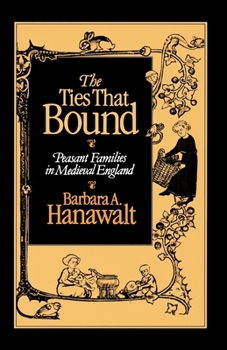
The Ties That Bound: Peasant Families in Medieval England


Select Format
Select Condition 
Book Overview
Barbara A. Hanawalt's richly detailed account offers an intimate view of everyday life in Medieval England that seems at once surprisingly familiar and yet at odds with what many experts have told us. She argues that the biological needs served by the family do not change and that the ways fourteenth- and fifteenth-century peasants coped with such problems as providing for the newborn and the aged, controlling premarital sex, and alleviating the harshness of their material environment in many ways correspond with our twentieth-century solutions. Using a remarkable array of sources, including over 3,000 coroners' inquests into accidental deaths, Hanawalt emphasizes the continuity of the nuclear family from the middle ages into the modern period by exploring the reasons that families served as the basic unit of society and the economy. Providing such fascinating details as a citation of an incantation against rats, evidence of the hierarchy of bread consumption, and descriptions of the games people played, her study illustrates the flexibility of the family and its capacity to adapt to radical changes in society. She notes that even the terrible population reduction that resulted from the Black Death did not substantially alter the basic nature of the family.
Format:Paperback
Language:English
ISBN:0195045645
ISBN13:9780195045642
Release Date:January 1988
Publisher:Oxford University Press
Length:364 Pages
Weight:0.99 lbs.
Dimensions:0.9" x 5.5" x 8.6"
Customer Reviews
4 ratings
A Lively Analysis of Medieval English Peasants
Published by Thriftbooks.com User , 17 years ago
In this book, Hanawalt investigates the peasant family in medieval England, attempting to correct some misconceptions of previous scholarship on the subject. Her thesis is explicit: "the peasant family remained much the same throughout these two centuries of cataclysmic changes [fourteenth and fifteenth] and, moreover, ... the family was able to maintain its basic structure because it was a remarkably flexible institution, permitting the pursuit of a variety of options while retaining the integrity of the unit" (3). Hanawalt's book surveys all aspects of English peasant families. In the first section of the book, Hanawalt provides an illuminating discussion on the material environment of the English peasantry, e.g., what kinds of fields they cultivated and what kinds of houses they built. The heart of Hanawalt's book comes in the second section where she defines the peasant family. She seeks to destroy what she calls "the myth of extended kinship in the Middle Ages" (83). She claims that English peasants conceived of the family as a relatively compact unit. The basic family structure was the nuclear family, which rarely exceeded five members. In the next two sections, Hanawalt looks at the economics of the family, describing how each member could contribute to the family's needs, and investigates each stage of life for the English peasant. Overall, Hanawalt posits a fairly rosy existence for medieval English peasants. One interesting aspect of the book is Hanawalt's choice of sources. She uses manorial court rolls and other traditional sources, but she really relies on coroner's reports to flesh out her argument. These coroner's reports give her survey plenty of color, but they also make the book a bit morbid at times. The combination of her upbeat picture of peasant life with a parade of ghastly accidents as evidence gives the reader a sensation of dissonance. Nonetheless, the book is a good read.
A good, solid study
Published by Thriftbooks.com User , 17 years ago
I have used this book for years as a text in a freshman level class on medieval and early modern Britain. Not only does it provide an in-depth look at the peasant family and community, it really shows how professional historians use sources. The conclusions are not revolutionary any more -- but the fact that this book seems so mainstream now is a testament to how good it really is.
Best book on medieval peasants
Published by Thriftbooks.com User , 21 years ago
This is the kind of academic text that can be read for pleasure. Incredibly learned, with a wonderful bibliography, Hanawalt manages to make coroner's reports (the basis of her text) engaging, funny, and illuminating. Never again can you take the image of peasants mucking around in filth as an accurate view of medieval peasant life. Instead, you will find them to be hardworking, ingenious, complex people. Hanawalt explores the material life (houses, lands, etc) as well as the social and economic lives peasants had, all with a great style. Not exactly a light read, but a fun one if medieval studies is your forte. Could use a few more maps, however, so brush up on your medieval English geography. Overall the best book on peasants I've encountered. Highly recommended.
Pretty decent for what it is.
Published by Thriftbooks.com User , 27 years ago
While, admitedly, I don't think I'd read this book without prompting, (I'm having to read it for a class), it is actually rather fascinating. The way in which the author uses coroner's reports to support her claims is particularly interesting, in a morbid sort of way.
Copyright © 2026 Thriftbooks.com Terms of Use
| Privacy Policy | Do Not
Sell/Share My Personal Information | Cookie Policy | Cookie Preferences | Accessibility Statement
ThriftBooks® and the ThriftBooks® logo are registered trademarks of Thrift Books Global, LLC
ThriftBooks® and the ThriftBooks® logo are registered trademarks of Thrift Books Global, LLC
