


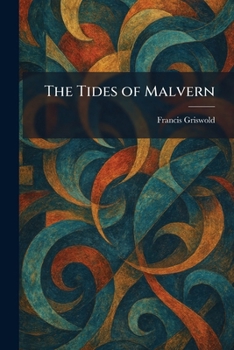
The Tides of Malvern

Select Format
Select Condition 
Book Overview
"The Tides of Malvern" is a sweeping family saga that chronicles the multi-generational history of the Sheldon family and their ancestral estate, Malvern, located near Charleston, South Carolina. Spanning from the colonial era through the aftermath of the First World War, the narrative captures the changing landscape of the American South through the eyes of successive generations. As the Sheldons navigate the turbulent waters of war, economic shifts, and social evolution, the plantation of Malvern stands as a silent witness to their triumphs and tragedies.
Francis Griswold masterfully weaves a tale of tradition, resilience, and the inescapable bonds of heritage. The novel explores themes of legacy and the enduring connection between a people and their land. Through vivid prose, "The Tides of Malvern" provides a profound look at the Southern experience, illustrating how the past continuously shapes the present. This work remains a significant contribution to Southern literature, offering a poignant reflection on the passage of time and the cyclical nature of human existence.
This work has been selected by scholars as being culturally important, and is part of the knowledge base of civilization as we know it. This work was reproduced from the original artifact, and remains as true to the original work as possible. Therefore, you may see the original copyright references, library stamps (as most of these works have been housed in our most important libraries around the world), and other notations in the work.
This work is in the public domain in the United States of America, and possibly other nations. Within the United States, you may freely copy and distribute this work, as no entity (individual or corporate) has a copyright on the body of the work.
As a reproduction of a historical artifact, this work may contain missing or blurred pages, poor pictures, errant marks, etc. Scholars believe, and we concur, that this work is important enough to be preserved, reproduced, and made generally available to the public. We appreciate your support of the preservation process, and thank you for being an important part of keeping this knowledge alive and relevant.
Customer Reviews
ThriftBooks ® and the ThriftBooks ® logo are registered trademarks of Thrift Books Global, LLC
