


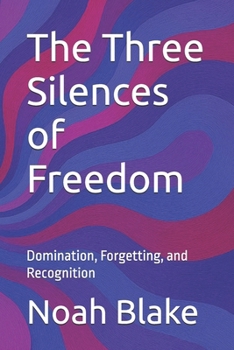
The Three Silences of Freedom: Domination, Forgetting, and Recognition
No Customer Reviews

ges, interwoven by a shared unease. Pettit offers us an architecture where freedom is not the silence of power but the actual possibility of contesting it. His notion of "non-domination" breaks with the minimalist view of freedom as non-interference. In his model, the citizen is free not because the state abstains but because guarantees and mechanisms of contestation bind power. Freedom, for Pettit, is architecture-with walls against arbitrariness and windows open to deliberation. Elegant, necessary, but insufficient. It is Honneth who intervenes where Pettit falls silent: in the realm of identities and invisible wounds. His theory of recognition reminds us that there is no authentic freedom where the subject is not validated, heard, or named. Freedom is not merely voting or voicing opinions-it is being someone in the eyes of another. Without love, respect, and social esteem, the individual becomes a specter: formally free but existentially alienated. In Honneth, freedom is the relation-a fragile thread between the self and the world. However, neither norm nor relation suffices. Form is also required-and here, Spengler raises his somber, prophetic voice. His thought does not instruct; it laments. He writes as one witnessing the slow death of a world that has forgotten what it means to be free. For him, great cultures once expressed an ethos of freedom-not as a rule, but as destiny. When myths become statistics and monuments deteriorate into administrative ruins, freedom loses its aura. In Spengler, it is a myth-a living narrative that endows the world with meaning. This book does not propose choosing among these authors nor artificially reconciling them. It proposes leaving them in friction, confrontation, and perhaps mutual recognition. The freedom that emerges here is not a definition but an experience-a practice that demands open institutions, legitimate emotions, and vibrant cultural forms. Freedom is constructed in the gesture of listening, in arenas of contestation, and shared symbols. Freedom is incarnated in bodies, laws, and narratives. Above all, this book is an invitation. It is an invitation to think of freedom not as something given but as something built. Not as a guarantee once and for all but as something cultivated daily. Something that resists, eludes, insists-even when language fails, even before collapse. Freedom, here, is labor-of memory, of relation, of care for form. In the chapters that follow, each author will be summoned to speak-and to listen. Pettit will lead us through normative republicanism and its mechanisms against arbitrariness. Honneth will descend into lived experience, where freedom reveals itself as collective self-realization. Spengler will bring the necessary shadow, reminding us that forms without souls may wither if not nourished by a shared imagination. This book is thus a passage. A passage through three ways of thinking freedom-and, more profoundly, three ways of sensing time. Freedom is not merely a political or ethical problem. It is, above all, a temporal question of how we inhabit the present, interpret the past, and project the future. Freedom is the name of the promise of what is yet to come.
Format:Paperback
Language:English
ISBN:B0FDL8FFGV
ISBN13:9798288519376
Release Date:June 2025
Publisher:Independently Published
Length:72 Pages
Weight:0.24 lbs.
Dimensions:0.2" x 6.0" x 9.0"
Customer Reviews
0 rating
Copyright © 2026 Thriftbooks.com Terms of Use
| Privacy Policy | Do Not
Sell/Share My Personal Information | Cookie Policy | Cookie Preferences | Accessibility Statement
ThriftBooks® and the ThriftBooks® logo are registered trademarks of Thrift Books Global, LLC
ThriftBooks® and the ThriftBooks® logo are registered trademarks of Thrift Books Global, LLC
