


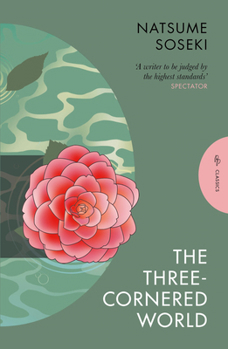
The Three-Cornered World

Select Format
Select Condition 
Book Overview
An artist on holiday at a mountain hot spring becomes fixated on a mysterious local beauty in this Japanese classic. "Soseki is the representative modern Japanese novelist, a figure of truly national stature." - Haruki Murakami One of the foundational classics of modern Japanese literature, this profound, meditative novel about repressed longing and aesthetic rapture shows legendary Japanese writer Natsume Soseki at his very best. A nameless young artist travels into the mountains, in search of the refreshments of nature. Staying at a small hot spring hotel, he soaks in the water and takes walks nearby, always with the intention of painting - though he never seems to get around to actually doing so. Instead, he finds himself transfixed by the daughter of the hotel owner, an enigmatic young beauty. His preoccupation is neither romantic nor sexual, but aesthetic: why is he so drawn to O-Nami's changeable face, now hostile, now serene? And what prevents him finally putting brush to paper and painting her picture? As the holiday goes on, these two circle each other, pursuing barbed yet friendly conversations about art and despair. And the more he learns about her life - a divorce, a rumoured entanglement with a local priest, a cousin in the army about to travel to the Manchurian front - the more he comes to realise that experiencing O-Nami's beauty to the full requires not just gazing upon her, but understanding her. Lushly poetic and stunningly sensitive, The Three-Cornered World is a masterful exploration of the beauty of nature, the artist's temperament, and the hidden springs of human sympathy.
Format:Paperback
Language:English
ISBN:1805332503
ISBN13:9781805332503
Release Date:October 2026
Publisher:Pushkin Press Classics
Length:224 Pages
Weight:0.81 lbs.
Customer Reviews
2 ratings
A Midspring Night's Dream
Published by Thriftbooks.com User , 18 years ago
"Kusamakura" is surely one of the weirdest novels of the twentieth century. A very early work by Natsume Soseki, who would go on to be one of Japan's foremost novelists, it's a pioneering one-shot experiment with what the author himself called a "Haiku novel" years before Kawabata Yasunari got the credit for such with his Palm-of-the-Hand Stories. A novel without a plot, where nothing of note really happens, and yet it's an endlessly engaging tale. Or is it a philosophical treatise on aesthetics narrated in the form of a story? Breathtakingly ethereal one moment, it's hilariously crass the next. In genre, it's a heady fusion of the Western novel and the Eastern poem equally at home with Percy Shelley and Yosa Buson, John Millais and Katsushika Hokusai, Oscar Wilde and the Tales of Ise, Christ and Bodhidharma. Staunchly nostalgic and even a tad traditionalist in an age when such things were being pell-mell thrown along the wayside, and yet modernist about a decade or so before its time--arguably ever bit as experimental as Joyce's "Ulysses" in many ways and yet a hundred times more readable and, yes, enjoyable. Indeed, everything I've said up to now may make "Kusamakura" seem rather portentous, but as a work of literature it's utterly unpretentious and approachable. It also so happens, as you may have guessed, to be one of my all time personal favorites. Which is why nobody could be more thrilled to see "Kusamakura" newly translated and published by Penguin--the folks who have been making classics approachable for decades. Meredith McKinney's new translation here is nothing less than excellent. Unpretentious as it is, "Kusamakura" is nowadays something of a hard nut to crack linguistically speaking, filled as it is with deliberate archaisms of an ornate nature on the one hand and cockney-esque colloquialisms on the other (among other slight puzzlers now obscure in contemporary printed Japanese) and yet McKinney handles Soseki's many voices and sometimes elliptical narration with a surefire grasp of the language and manages to convey the same in highly fluent and idiomatic English. It's carefully accurate and true to the original and yet makes itself at home in its new language to a degree that seems natural and easy but must in fact have entailed much hard work and scholarly care. This edition is also judiciously supplemented with unobtrusive but helpful endnotes following up on Soseki's principal references, and the introduction does a fine job of adequately situating this idiosyncratic classic in the context of Soseki's larger opus and of contextualizing both within the larger framework of Japanese literature and history at the turn of the (last) century without unduly overburdening the book. In short, this is a wonderful edition of a wonderful book--totally flawless. Okay, not totally; when you first open the book and glance at the half-title page, you'll see in the little blurb the dates for the Meiji period incorrectly given as 1868-1914 in
Will the Artist Ever escape the Wheel of Existence? Sould He?
Published by Thriftbooks.com User , 18 years ago
There are many themes examined in The Three Cornered world, the most predominant being the interior thoughts of the painter-poet on his vision quest. Much mush has been written of the Japanese poets' concern with nature, but here, for all its landscapes and mountains and moons and spring airs, we see what that nature poetry is truly all about. Nature in Soseki (For, among other things, Soseki is creating, not only a novel, but expressing a theory of aesthetics) is not an object apart from the artist (Who is different from most people) it is a sense object, and nature is not the thing, but the source of sensual awareness. Japan is a sensual country, and the Japanese are a sensual people. The Japanese, for all their supposed rigidity and formality, are deeply emotional and intense, and are the most avowedly aesthetic (Not rational, not formal, but artistic) culture that our species has produced. The Three Cornered World examines this theme of the artist in the world and connects this theme to a more general concept of the artist as a person aware of the world's artists--at least the asthetics of China and England--in a manner that suggests the importance and value and uncertainty of the life of the artist. While Soseki longs for a Buddhist escape from the "Real" world, at the same time, his artist is at his most absurd, even silly, when he acheives that escape from the real world. No matter what, the man is never more alive, more real, than when he is with the incredible O-Nami, and he is never more in the world than when thinking of her. As with many real Japanese women, no man worthy of living would fail to fall in love with her, as Soseki's protagonist certainly does. I did.
Copyright © 2026 Thriftbooks.com Terms of Use
| Privacy Policy | Do Not
Sell/Share My Personal Information | Cookie Policy | Cookie Preferences | Accessibility Statement
ThriftBooks® and the ThriftBooks® logo are registered trademarks of Thrift Books Global, LLC
ThriftBooks® and the ThriftBooks® logo are registered trademarks of Thrift Books Global, LLC
