


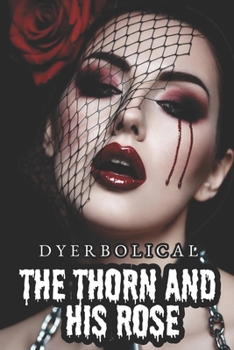
The Thorn and His Rose

The Thorn and His Rose is a baroque descent into obsession, power, and eroticised annihilation, charting the catastrophic relationship between Valkyrie, a forensic therapist turned aesthetic executioner, and Dyer-Bolique, a charismatic predator who wears civility like a costume stitched from skin.
Structured as a polyphonic operetta of murders, duets, rituals, and mutual dreams, the narrative unfolds across acts that resemble a grotesque ballet rather than a linear crime story. Each scene is framed as performance, therapy session, feast, hunt, card game, dance, or sacrament, while the pair enact a private cosmology in which justice is indistinguishable from desire.
Their relationship is not romantic in any conventional sense. It is symbiotic and parasitic, built upon mirrored psychopathy, erotic cruelty, and the belief that monstrosity can be refined into art. Victims are selected not for convenience but for symbolic worth. Their deaths become aesthetic arguments. The murders escalate from vigilantism to ritualised annihilation, until Dyer-Bolique's manipulation eclipses Valkyrie's agency entirely, transforming her from sovereign predator into imprisoned artefact.
Interspersed dream sequences transport the narrative into gothic realms of vampiric possession and psychic submission, dissolving the boundary between fantasy and captivity. These visions reveal the core tragedy of the text: Valkyrie does not simply fall in love with a monster, she internalises him, becoming the architecture of her own erasure.
By the final act, The Thorn and His Rose is no longer about murder, but about authorship. Who controls the story when desire itself becomes the weapon. Who survives when the self is consumed in the name of intimacy. And whether disappearance, rather than death, is the final form of resistance.
Context of CreationThe Thorn and His Rose was conceived and written during the early 2020s as part of Dyerbolical's Necro Times cycle, a period of experimental horror authorship that blurred fiction, performance, and digital intimacy. The work emerged within online micro publics structured by serial posting, threaded improvisation, and affective escalation, environments that rewarded intensity while eroding ethical containment.
The text is not merely a novel. It is a residue of lived participatory practice. Its fragmented structure, alternating voices, ritualised killings, and dream-state interludes replicate the rhythms of collaborative horror performance that dominated platforms such as X, Wattpad, and AO3 during the pandemic era. Lockdown conditions provided both the temporal affordance and psychological pressure required for prolonged immersion, allowing the project to expand beyond traditional narrative limits into a multimodal artefact of relational collapse.
The characters Valkyrie and Dyer-Bolique were not designed as archetypes, but evolved through performative autoethnographic engagement. Their dynamic encodes the structural asymmetries observed within digital horror microverses, where feminised participants disproportionately absorb emotional, ethical, and narrative labour in order to stabilise volatile scenes. Valkyrie's progressive loss of sovereignty mirrors the invisible work required to sustain participatory intimacy in environments that privilege escalation over care.
This work therefore functions as both fiction and theoretical document. It dramatizes what later research would formalise as Violent Erotic Reorientation and Ethical Fracture: the attempt to tenderise monstrous masculinity through intimacy, and the inevitable collapse of that labour when relational containment becomes unsustainable.
Customer Reviews
ThriftBooks ® and the ThriftBooks ® logo are registered trademarks of Thrift Books Global, LLC
