


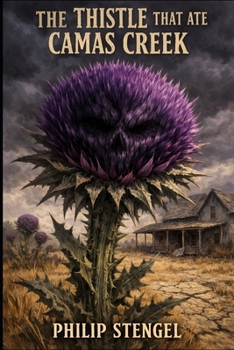
The Thistle That Ate Camas Creek

After her parents' deaths, property appraiser Claire Rasmussen returns to the family farm outside Camas Creek, Idaho, expecting grief, deferred maintenance, and a hard sale. Instead she finds a house that no longer agrees with memory. The driveway curves wrong. The fence line bows where it should run straight. The porch swing hangs on the wrong side of the house, and old photographs insist it was always there. Beyond the barn, her father's long war with the pasture thistle is over, and the thistle has won.
The patch in the south field is no longer a patch. It is a kingdom of towering stalks, wet purple blooms, animal carcasses worked into the growth, and a low hum that seems to rise through wood, teeth, and memory itself. Claire's teenage son Jonah is drawn toward it first. Her husband Mark tries to cut it back with ordinary tools and ordinary confidence. Ruth Langley, the last neighbor willing to speak plainly, offers the only rule that matters: don't tend it, don't water it, don't let it have the night. By then it is already too late. The thistle does not simply spread. It corrects. It teaches the land, the house, and the people living beside it to agree with the wrong version of things.
As Claire digs into vanished locals, overwritten records, and the old names the town has half forgotten, she discovers the truth beneath Camas Creek's silence: the thistle is not a weed in any ordinary sense. It is an occupying intelligence that feeds on loneliness, memory, and the human habit of letting the wrong thing become normal if it arrives slowly enough. The Thistle That Ate Camas Creek is rural psychological horror about grief, land, and the terror of realizing that some infestations do not choke a place all at once. They teach it to welcome them.
Customer Reviews
ThriftBooks ® and the ThriftBooks ® logo are registered trademarks of Thrift Books Global, LLC
