


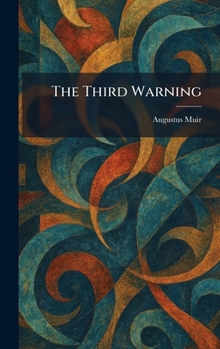
The Third Warning

"The Third Warning" is a compelling mystery and suspense thriller that showcases Augustus Muir's talent for crafting atmospheric and high-stakes narratives. The story revolves around a sequence of ominous threats and a mystery that deepens with every turn, drawing its characters into a labyrinth of danger where the stakes are life and death. As the titular warnings manifest, the protagonist must navigate a series of perilous encounters to uncover the truth behind a hidden conspiracy.
Representative of the classic adventure-mystery genre of the early 20th century, the work emphasizes tension, psychological pressure, and the clever resolution of intricate plots. Muir's writing is characterized by its brisk pacing and its ability to transport the reader into a world of shadows and uncertainty. "The Third Warning" stands as a significant example of British popular fiction from the 1920s, offering a gripping experience for fans of vintage detective stories and traditional thrillers. Its blend of action and intrigue ensures its place as a quintessential piece of period suspense literature.
This work has been selected by scholars as being culturally important, and is part of the knowledge base of civilization as we know it. This work was reproduced from the original artifact, and remains as true to the original work as possible. Therefore, you may see the original copyright references, library stamps (as most of these works have been housed in our most important libraries around the world), and other notations in the work.
This work is in the public domain in the United States of America, and possibly other nations. Within the United States, you may freely copy and distribute this work, as no entity (individual or corporate) has a copyright on the body of the work.
As a reproduction of a historical artifact, this work may contain missing or blurred pages, poor pictures, errant marks, etc. Scholars believe, and we concur, that this work is important enough to be preserved, reproduced, and made generally available to the public. We appreciate your support of the preservation process, and thank you for being an important part of keeping this knowledge alive and relevant.
Customer Reviews
ThriftBooks ® and the ThriftBooks ® logo are registered trademarks of Thrift Books Global, LLC
