


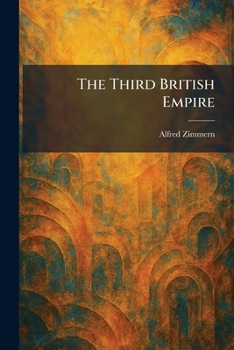
The Third British Empire

"The Third British Empire" is a seminal study by Alfred Zimmern that explores the profound transformation of the British Empire in the wake of the First World War. Written during a pivotal era of global transition, the work examines the shift from a centralized imperial structure to a voluntary association of free and equal states, which Zimmern characterizes as the 'Third' phase of British imperial history.
The book delves into the complex legal, political, and social changes that defined the emergence of the British Commonwealth of Nations. Zimmern, a key figure in the development of international relations theory, analyzes the Empire's role within the newly formed League of Nations and its capacity to maintain unity through shared ideals rather than coercive force. By addressing themes of nationalism, internationalism, and democratic governance, the text provides a sophisticated perspective on how a global power adapted to the demands of a modern, post-war world.
This work remains a significant resource for understanding 20th-century political thought and the evolution of modern international cooperation. It offers readers a unique window into the intellectual foundations of the Commonwealth and the historical forces that reshaped global diplomacy in the interwar period.
This work has been selected by scholars as being culturally important, and is part of the knowledge base of civilization as we know it. This work was reproduced from the original artifact, and remains as true to the original work as possible. Therefore, you may see the original copyright references, library stamps (as most of these works have been housed in our most important libraries around the world), and other notations in the work.
This work is in the public domain in the United States of America, and possibly other nations. Within the United States, you may freely copy and distribute this work, as no entity (individual or corporate) has a copyright on the body of the work.
As a reproduction of a historical artifact, this work may contain missing or blurred pages, poor pictures, errant marks, etc. Scholars believe, and we concur, that this work is important enough to be preserved, reproduced, and made generally available to the public. We appreciate your support of the preservation process, and thank you for being an important part of keeping this knowledge alive and relevant.
Customer Reviews
ThriftBooks ® and the ThriftBooks ® logo are registered trademarks of Thrift Books Global, LLC
