


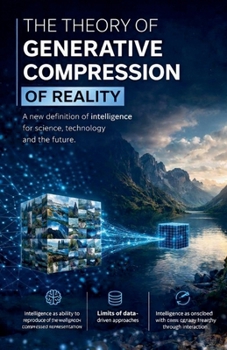
The Theory of Generative Compression of Reality

The Theory of Generative Compression of Reality proposes a fundamental redefinition of intelligence, shifting it from a function-based or system-specific property to a structural relation between representation and reality. Instead of viewing intelligence as the accumulation of knowledge or optimization over datasets, the work frames it as the ability to reproduce the complexity of the world from a maximally compressed internal representation.
At the core of the theory lies a simple but far-reaching idea: any intelligent system operates by constructing a representation ( C_{repr} ) that, through a generative process ( G ), produces behavior consistent with reality ( R ). This reframing unifies biological and artificial systems under a single formal condition, independent of implementation details. Intelligence becomes not what a system stores, but how efficiently it encodes and reconstructs structure.
The work critically examines the limitations of the prevailing data-driven paradigm in artificial intelligence. It demonstrates that optimization over datasets inevitably leads to surface-level compression, distribution dependence, and fragile generalization. Increasing model size, data volume, or computational resources does not resolve this issue, as these limitations arise from the structure of the problem itself rather than its scale.
To address this, the theory introduces a transition from passive data consumption to active interaction with reality. Intelligence is redefined as the ability to maintain consistency with a dynamic environment over time. This leads to a shift from static evaluation metrics to stability of interaction as the primary criterion of quality. In this framework, learning is no longer a process of fitting data, but of continuously adapting representations under real-world constraints.
The implications extend beyond artificial intelligence into a broader unification of disciplines. Biology, physics, and computer science are reinterpreted as studying different aspects of the same underlying process: the formation and maintenance of coherent representations under resource constraints. This enables transfer of principles across domains, not at the level of mechanisms, but at the level of structural invariants.
The theory also introduces a minimal architecture required for intelligence, consisting of compression, generation, error detection, adaptation, and constraint mechanisms, organized in a closed interaction loop. Within this structure, a critical transition emerges: when generation becomes computationally cheaper than explicit calculation, systems exhibit behavior commonly associated with intuition.
Rather than offering a specific algorithm or model, this work provides a conceptual and formal framework for rethinking intelligence. It identifies the limits of current approaches and outlines a direction for developing systems capable of deeper generalization and устойчивого взаимодействия with reality. For researchers and engineers, it serves as both a critique of existing paradigms and a foundation for new architectures of intelligent systems.
Customer Reviews
ThriftBooks ® and the ThriftBooks ® logo are registered trademarks of Thrift Books Global, LLC
