


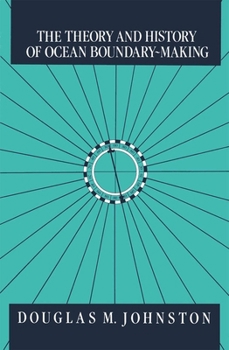
The Theory and History of Ocean Boundary-Making
No Customer Reviews

In this book Douglas Johnston provides a synthesis of all disciplines relevant to any aspect of boundary-making. He outlines the general theory of boundary-making, reviews the modern history of all modes of boundary-making in the ocean, and provides a theoretical framework for the analysis and evaluation of ocean boundary claims, practices, arrangements, and settlements. The author suggests that as bilateral treaty-making continues, significant boundary delimitation patterns will emerge, some of which may prove useful in non-oceanic contexts of boundary-making and natural resource management such as Antarctica, airspace and outerspace, and international lakes and rivers.
Format:Hardcover
Language:English
ISBN:0773506241
ISBN13:9780773506244
Release Date:September 1988
Publisher:McGill-Queen's University Press
Length:464 Pages
Weight:2.10 lbs.
Dimensions:1.4" x 6.2" x 9.0"
Related Subjects
LawCustomer Reviews
0 rating
Copyright © 2026 Thriftbooks.com
Terms of Use | Privacy Policy | Do Not Sell/Share My Personal Information | Cookie Notice | Cookie Preferences | Accessibility Statement
ThriftBooks ® and the ThriftBooks ® logo are registered trademarks of Thrift Books Global, LLC
ThriftBooks ® and the ThriftBooks ® logo are registered trademarks of Thrift Books Global, LLC
