


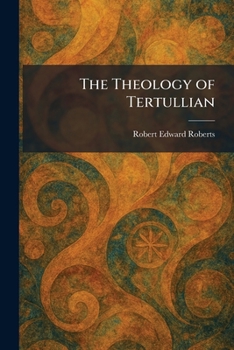
The Theology of Tertullian

"The Theology of Tertullian" provides an in-depth exploration of the religious thought and doctrinal contributions of one of the most influential figures in early Christianity. Written by Robert Edward Roberts, this scholarly work examines the life and writings of Tertullian, the prolific North African author often hailed as the father of Latin Christianity. The text delves into his formative role in shaping the terminology and conceptual framework of the Western Church, particularly his foundational contributions to the doctrine of the Trinity.
Through a careful analysis of Tertullian's treatises, the book addresses key theological themes including the nature of God, the person of Christ, the role of the Holy Spirit, and the relationship between faith and reason. Roberts also considers the historical context of the second and third centuries, highlighting how Tertullian navigated the tensions between nascent orthodoxy and various movements like Gnosticism and Montanism. This volume serves as an essential resource for students of patristics, historical theology, and the evolution of early Christian dogma, offering a clear and systematic overview of a complex thinker whose legacy continues to resonate in modern theological discourse.
This work has been selected by scholars as being culturally important, and is part of the knowledge base of civilization as we know it. This work was reproduced from the original artifact, and remains as true to the original work as possible. Therefore, you may see the original copyright references, library stamps (as most of these works have been housed in our most important libraries around the world), and other notations in the work.
This work is in the public domain in the United States of America, and possibly other nations. Within the United States, you may freely copy and distribute this work, as no entity (individual or corporate) has a copyright on the body of the work.
As a reproduction of a historical artifact, this work may contain missing or blurred pages, poor pictures, errant marks, etc. Scholars believe, and we concur, that this work is important enough to be preserved, reproduced, and made generally available to the public. We appreciate your support of the preservation process, and thank you for being an important part of keeping this knowledge alive and relevant.
Customer Reviews
ThriftBooks ® and the ThriftBooks ® logo are registered trademarks of Thrift Books Global, LLC
