


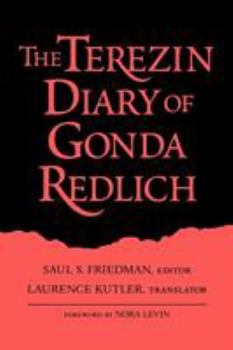
Terezin Diary of Gonda Redlich-Pa

Select Format
Select Condition 
Book Overview
In 1941, the fortress city of Terezin, outside Prague, was ostensibly converted into model ghetto, where Jews could temporarily reside before being sent to a more permanent settlement. In reality it was a way station to Auschwitz. When young Gonda Redlich was deported to Terezin in December of 1941, the elders selected him to be in charge of the youth welfare department. He kept a diary during his imprisonment, chronicling the fear and desperation of life in the ghetto, the attempts people made to create a cultural and social life, and the disease, death, rumors, and hopes that were part of daily existence. Before his own deportation to Auschwitz, with his wife and son, in 1944, he concealed his diary in an attic, where it remained until discovered by Czech workers in 1967.
Format:Paperback
Language:English
ISBN:B005S0U1UG
ISBN13:9780813109602
Release Date:January 1999
Publisher:University Press of Kentucky
Length:192 Pages
Weight:0.78 lbs.
Dimensions:0.5" x 6.2" x 9.2"
Grade Range:Postsecondary and higher
Related Subjects
Biographies Czech Republic Ethnic & National Europe Historical History Jewish WorldCustomer Reviews
2 ratings
Heartbreaking in its simplicity
Published by Thriftbooks.com User , 17 years ago
This is not a book to start with when reading about the Holocaust. Theresienstadt, the Potemkin village ghetto, was an unusual place and Redlich's experience there is not as universal as some, like Elie Wiesel. The book demands a fair amount of knowledge about the events of the Holocaust. That said, it's one of the most moving documents I've read from the period. Unlike Anne Frank, Redlich writes from within the eye of the hurricane, rather than at its edges. His hope, tempered with his ignorance of his own fate, is wrenching, especially when his child is born and he writes the last few chapters as his son's diary. It literally brought me to tears. Highly recommended.
Life and Death in the "Paradise" concentration camp
Published by Thriftbooks.com User , 25 years ago
The Diary of Gonda Redlich is an enlightening tale of life and death within Theresienstadt, the "resort" or "paradise" concentration camp of the Jewish Holocaust. Throughout the course of the diary, we see Theresienstadt from the first hand experiences of Gonda, the head of children's affairs and the transports. We learn of all of the great cultural activities of Theresienstadt, while we learn of the transports east to Auschwitz, the greatest death camp of all. The first hand experiences and writings of Gonda provide envaluable information to any serious historian of the Jewish Holocaust. Can any person read this book? Must you be a historian? No, I believe that this book can be read by anybody. It is a timeless tale of life (with the birth of Gonda's son and the activities in Theresienstadt) and death (Gonda eventually was sent to die in Auschwitz) in the final solution. It is first hand proof for the world of the horrors and sometimes joys in the Jewish Holocaust.
Copyright © 2026 Thriftbooks.com Terms of Use
| Privacy Policy | Do Not
Sell/Share My Personal Information | Cookie Policy | Cookie Preferences | Accessibility Statement
ThriftBooks® and the ThriftBooks® logo are registered trademarks of Thrift Books Global, LLC
ThriftBooks® and the ThriftBooks® logo are registered trademarks of Thrift Books Global, LLC
