


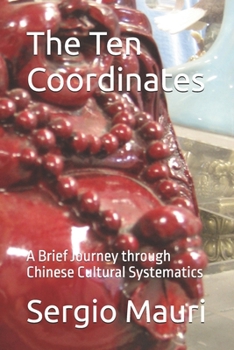
The Ten Coordinates: A Brief Journey through Chinese Cultural Systematics
No Customer Reviews

This book explores the ten fundamental coordinates of Chinese civilization, the result of a decade-long research effort into a millennial journey. The narrative begins with the legendary Yan Di and Huang Di, the ancestral figures credited with the birth of Chinese agriculture, medicine, and governance. It then traverses the Spring and Autumn and Warring States periods, a time of political fragmentation that paradoxically sparked the "Golden Age" of Chinese philosophy, most notably Confucianism, which established the ethical and social foundations of the nation.
The historical trajectory highlights the Qin Dynasty, which achieved China's first unification and standardized its language, followed by the Western Han, where Confucianism was formally adopted as the state ideology. The Eastern Han period is noted for the transformative arrival of Buddhism via the Silk Road, leading to a profound spiritual synthesis.
The summary reaches the Tang Dynasty, celebrated as a cosmopolitan golden age of poetry and technological breakthroughs like gunpowder, and the Song Dynasty, which refined Chinese thought through Neo-Confucianism, integrating metaphysical insights into a systematic philosophy. The later Qing Dynasty illustrates the complex governance of a Manchu minority ruling over a Han majority, maintaining traditions while expanding the empire. Finally, the journey concludes with the Republic of China in 1912, marking the end of imperial rule and the definitive introduction of Western ideals of democracy and science.
The historical trajectory highlights the Qin Dynasty, which achieved China's first unification and standardized its language, followed by the Western Han, where Confucianism was formally adopted as the state ideology. The Eastern Han period is noted for the transformative arrival of Buddhism via the Silk Road, leading to a profound spiritual synthesis.
The summary reaches the Tang Dynasty, celebrated as a cosmopolitan golden age of poetry and technological breakthroughs like gunpowder, and the Song Dynasty, which refined Chinese thought through Neo-Confucianism, integrating metaphysical insights into a systematic philosophy. The later Qing Dynasty illustrates the complex governance of a Manchu minority ruling over a Han majority, maintaining traditions while expanding the empire. Finally, the journey concludes with the Republic of China in 1912, marking the end of imperial rule and the definitive introduction of Western ideals of democracy and science.
Format:Paperback
Language:English
ISBN:B0G5JL7MFM
ISBN13:9798277785812
Release Date:December 2025
Publisher:Independently Published
Length:140 Pages
Weight:0.43 lbs.
Dimensions:0.3" x 6.0" x 9.0"
Customer Reviews
0 rating
Copyright © 2026 Thriftbooks.com
Terms of Use | Privacy Policy | Do Not Sell/Share My Personal Information | Cookie Policy | Cookie Preferences | Accessibility Statement
ThriftBooks ® and the ThriftBooks ® logo are registered trademarks of Thrift Books Global, LLC
ThriftBooks ® and the ThriftBooks ® logo are registered trademarks of Thrift Books Global, LLC
