


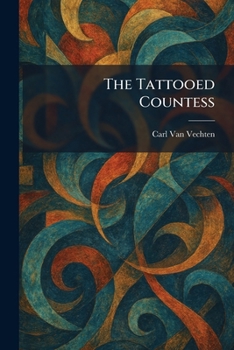
The Tattooed Countess

Select Format
Select Condition 
Book Overview
"The Tattooed Countess" is a sophisticated social satire that explores the sharp clash between European cosmopolitanism and American provincialism in the early 20th century. The story follows the elegant Countess Ella Nattatorrini, a refined and worldly woman who returns to her conservative hometown of Maple Valley, Iowa, following a series of romantic disappointments and scandals in Europe. As she attempts to navigate the rigid social structures of the Midwest, her presence becomes a catalyst for both fascination and moral outrage among the local residents.
Carl Van Vechten's sharp-witted narrative delves into themes of nostalgia, the passage of time, and the stifling nature of small-town conventions. The novel provides a vivid portrait of the 1920s, capturing the tension between the yearning for modern sophistication and the persistence of traditional values. Through the eyes of the Countess, readers witness a humorous yet poignant critique of social hypocrisy and the struggle for personal expression in a community bound by strict decorum. "The Tattooed Countess" remains a significant work of American realism, celebrated for its elegant prose and its insightful commentary on the cultural divides of the Jazz Age.
This work has been selected by scholars as being culturally important, and is part of the knowledge base of civilization as we know it. This work was reproduced from the original artifact, and remains as true to the original work as possible. Therefore, you may see the original copyright references, library stamps (as most of these works have been housed in our most important libraries around the world), and other notations in the work.
This work is in the public domain in the United States of America, and possibly other nations. Within the United States, you may freely copy and distribute this work, as no entity (individual or corporate) has a copyright on the body of the work.
As a reproduction of a historical artifact, this work may contain missing or blurred pages, poor pictures, errant marks, etc. Scholars believe, and we concur, that this work is important enough to be preserved, reproduced, and made generally available to the public. We appreciate your support of the preservation process, and thank you for being an important part of keeping this knowledge alive and relevant.
Customer Reviews
ThriftBooks ® and the ThriftBooks ® logo are registered trademarks of Thrift Books Global, LLC
