


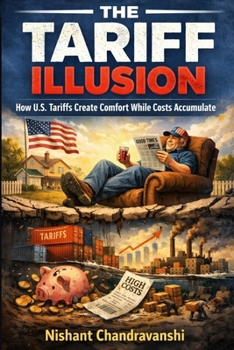
The Tariff Illusion: How U.S. Tariffs Create Comfort While Costs Accumulate

How U.S. Tariffs Create Comfort While Costs Accumulate
Tariffs rarely fail on impact.
They fail on delay.
That is why they survive.
The Tariff Illusion is a deep examination of how powerful systems make decisions under pressure-and why those decisions feel correct long before they quietly erode strength.
This is not a book about trade theory.
It is a book about judgment.
When economic stress rises, governments do not choose the best long-term option.
They choose the option that calms anxiety fastest.
Tariffs do that better than almost anything else.
They are visible.
They are simple.
They signal control.
And that signal matters more, early on, than results.
Drawing on historical patterns, sector-level timelines, and incentive analysis, this book shows how tariffs function less as economic tools and more as psychological relief mechanisms-reducing uncertainty immediately while pushing real costs into the future, where they are harder to connect, harder to measure, and harder to reverse.
The book follows a clear, repeatable sequence:
- Pressure collapses choice
- Comfort arrives before understanding
- Costs disperse quietly across consumers, firms, and time
- Delay breaks accountability
- Judgment hardens into defense
Rather than arguing whether tariffs "work," the book asks a more uncomfortable question:
Why do systems keep choosing policies that feel stabilizing early-even when they weaken competitiveness, innovation, and resilience later?
You will see how:
- Concentrated benefits dominate early narratives while dispersed costs remain invisible
- Metrics replace meaning, turning short-term calm into proof of success
- Industries absorb damage on different timelines, masking systemic decline
- Adaptation creates dependence, making reversal feel more dangerous than staying wrong
- Institutions learn to manage protection instead of preparing for competition
This is not a critique of any administration, party, or ideology.
No villains are named.
No prescriptions are offered.
The analysis assumes competent decision-makers responding rationally to incentives that reward speed, visibility, and reassurance.
That is precisely the problem.
Because when comfort arrives early, judgment rarely returns on time.
By the time costs become undeniable, the decision that caused them feels historical, settled, and politically untouchable. What remains looks like "the way things are," not the result of a choice made under pressure.
If you are looking for policy advice, this book is not for you.
If you are looking to understand how large systems quietly trade long-term strength for short-term calm-and why that trade keeps repeating-this book will change how you see familiar decisions.
You may not finish it feeling confident.
You will finish it seeing the mechanism.
And once you see it, comfort will never look free again.
Regards,
Nishant Chandravanshi
Related Subjects
Business Business & Investing Economics Political Science Politics & Social SciencesCustomer Reviews
ThriftBooks® and the ThriftBooks® logo are registered trademarks of Thrift Books Global, LLC
