


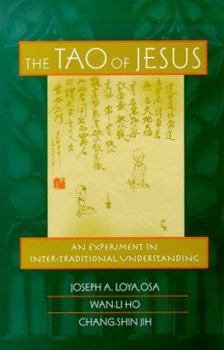
The Tao of Jesus : An Experiment in Inter-Traditional Understanding


Lines up statements from Jesus alongside statements from Taoism, and compares them, commenting on their similarities and differences. Useful in religious anthropology, comparative religion, and... This description may be from another edition of this product.
Format:Paperback
Language:English
ISBN:080913764X
ISBN13:9780809137640
Release Date:January 1
Publisher:Paulist Press
Length:185 Pages
Weight:0.60 lbs.
Dimensions:8.3" x 0.5" x 6.0"
Customer Reviews
5 ratings
An Eye-Opener For All Involved
Published by Thriftbooks.com User , 21 years ago
I have never read the Bible. I have read the Tao Te Ching. That said, I gained far more from this book than I ever thought possible. The introduction discusses the difference between religious discussion (in which both parties seek understanding of the other side's view) and religious argument (in which one party has to prove the other wrong). As a Reconstructionist Pagan, I know that I will be referring to that clarification often, as even I get overheated sometimes. The book then refers to themes found in both the Tao Te Ching and the Gospels. They are all in alphabetical order, so you can skip around and find those topics that interest you most. Some of the connections aren't particularly strong - the use of certain symbols, for example. Others cut straight to the philosophical core, clearly showing where the two schools of thought overlap and where they are in direct opposition. What I particularly liked was the fact that the scholars who analyzed both pieces of literature were not the authors themselves. There was no obvious effort to squeeze the literature into a format that would suit their argument the best. In fact, sometimes I forgot about the theme of the book entirely. Just learning more about the meaning (especially with the Scripture) was fascinating. It's a shame that the Taoists here are writing such poor reviews. Why can't Christians see Taoism in a fair light alongside something they already know? And why can't the Taoists appreciate some deeply moving works of another faith? In summary, if you love philosophy or are curious about either Taoism or Christianity, do get this book. It's an absolute delight.
Taoism and The observer.
Published by Thriftbooks.com User , 23 years ago
To be partand object part is to set apartfrom the whole (hole)Be at restand beEnjoy..Book is part -take from, give to or be with it your part.Add to - take from - be with itmake it part of you and you a part of it.Not bad - not great - good book and many stars.
A Kind Book
Published by Thriftbooks.com User , 25 years ago
I am puzzled over the hateful reviews of this book. The reviewers cannot have read the book, and seem to have a borderline pathological hatred of Christianity, or what they think is Christianity. The subtitle of this work really gives away its intentions: it is 1. experimental, and 2. understanding.My family is Chinese, and my grandfather was a Taoist priest back in China. We are practising Taoists, not new-age Taoists or disgruntled ex-Christains who read the Dao Deh Ch'ing and decided to call themselves Taoists. So I think that I can speak about this book. I find nothing offensive about its content, and I think that Jesus has much to teach Taoists. I wish a Taoist "theologian" would write a similar book, and I smile to think that maybe we are talking about the same thing. After reading this book, I am glad to be a Taoist, but I am appreciative of people like Br. Loya in the Christian tradition who take the time to understand and experiment with the edges of human faith.
The Gospels and the Tao Te Ching:Yin and Yang
Published by Thriftbooks.com User , 26 years ago
Most American Christians know little or nothing about one of the great religions of the East, Taoism. It is no doubt also the case that few Taoists know much about Christianity. In a very attractively designed and wonderfully titled book, The Tao of Jesus, Loya and his Chinese co-authors attempt to remedy this gap by presenting Jesus' yin to Lao Tsu and Chuang Tsu's yang. After a very helpful Introduction which contains both an "Introduction to Taoism" and a reflection on "Principles of Dialogue" for Christians, the book presents 54 themes, from "abundance" to 'vacuous superficiality." Each of these themes cites a quotation from Lao Tsu or Chuang Tsu or both, and another quotation attributed to Jesus in the Gospels. On the opposing pages, there are commentaries by the authors which serve as meditations from both Christian and Taoist perspectives on the theme or the quotations at hand. A paradigm of this format is the theme "Of life, death, and the logic of reversion" where the authors cite both Lao Tsu and Chuang Tsu to describe aporias that challenge human wisdom, as does for example the section from Lao Tsu's Tao Te Ching which observes: "Flexibility preserves wholeness; Bending leads to straightness; Hollowness leads to fullness, Wearing out leads to renewal; Deficit leads to gain; Plenitude leads to perplexity."This is compared to Jesus' dictum that "many who are first will be last, and the last will be first" and also with Luke's version of the beatitudes, as well as Jesus' observation about losing one's life to save it, and the importance of the grain of wheat dying before it can produce much fruit.In the commentary related to this theme, the authors both compare and contrast Taoist and Christian applications of the "logic of reversion" and cite both St. Paul and St. Maximus the Confessor to support their contention that "Living in Tao-harmony and living out the Christian ethos exhibit close similarity when fullness-of life and death-to-self are the terms of reversion." It seems that the authors' goal, much like the symbol of Taoism itself, is to show the interpenetration of Taoist and Christian values, even while demonstrating their uniqueness and difference. One could also argue that at the heart of the Christian Way is the Tao (the unnamable Way --- transcendence itself made immanent) and at the heart of the Taoist vision lurks "The Way, the Truth, and the Life."In addition to many fine meditations on the relationship between Taoism and Christianity, the book offers many original sketches drawn by the internationally respected Chinese artist, Yu Peng. These sketches enliven the text and give the book itself a wonderfully aesthetic flavor. There is also a list of sources in the back of the book that would be especially helpful to the Christian reader who wants to know more about Taoist thought.The book is subtitled as an "experiment' and it is not without its experimental flaws. I be
Excellent and balanced from both perspectives
Published by Thriftbooks.com User , 26 years ago
Anyone with even a modicum of understanding in either religious tradition will recognize this book to the be an heir of such classics as Merton's "Mystics and Zen Masters" and "The Way of Chuang-tzu." Loya has assembled ideas in a way that speak to the Tao as found in all things--especially these two venerable religious traditions. Scholars of religion will appreciate the way in which serious issues are handled with honesty, and with a critical eye for both paths at times. Popular readers will also be drawn into the detailed perspectives from both religious traditions without being overwhelmed by jargon. An honest approach to a very timely subject.
Copyright © 2026 Thriftbooks.com
Terms of Use | Privacy Policy | Do Not Sell/Share My Personal Information | Cookie Policy | Cookie Preferences | Accessibility Statement
ThriftBooks ® and the ThriftBooks ® logo are registered trademarks of Thrift Books Global, LLC
ThriftBooks ® and the ThriftBooks ® logo are registered trademarks of Thrift Books Global, LLC
