


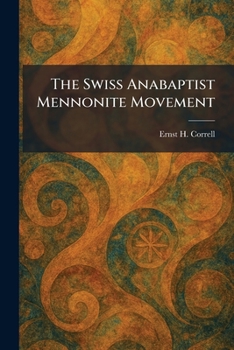
The Swiss Anabaptist Mennonite Movement

"The Swiss Anabaptist Mennonite Movement" provides a comprehensive historical and sociological analysis of the origins and development of the Anabaptist tradition within Switzerland. Ernst H. Correll explores the economic and social factors that shaped the Mennonite community, tracing their evolution from the Radical Reformation through centuries of persistence. This study examines the core tenets of the movement, including believer's baptism, non-resistance, and the separation of church and state.
By focusing specifically on the Swiss context, Correll highlights the unique challenges and cultural contributions of these communities. The work serves as a vital resource for understanding the sociological impact of dissenting religious groups and their role in the broader tapestry of European history. It offers deep insights into the internal organization of the movement, the socio-economic conditions of its members, and its enduring legacy in modern Mennonite identity. This scholarly examination remains a significant contribution to the study of religious history and the sociology of the Reformation era, emphasizing the intersection of faith and social order.
This work has been selected by scholars as being culturally important, and is part of the knowledge base of civilization as we know it. This work was reproduced from the original artifact, and remains as true to the original work as possible. Therefore, you may see the original copyright references, library stamps (as most of these works have been housed in our most important libraries around the world), and other notations in the work.
This work is in the public domain in the United States of America, and possibly other nations. Within the United States, you may freely copy and distribute this work, as no entity (individual or corporate) has a copyright on the body of the work.
As a reproduction of a historical artifact, this work may contain missing or blurred pages, poor pictures, errant marks, etc. Scholars believe, and we concur, that this work is important enough to be preserved, reproduced, and made generally available to the public. We appreciate your support of the preservation process, and thank you for being an important part of keeping this knowledge alive and relevant.
Customer Reviews
ThriftBooks ® and the ThriftBooks ® logo are registered trademarks of Thrift Books Global, LLC
