


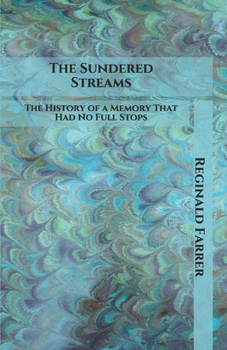
The Sundered Streams: The History of a Memory That Had No Full Stops
No Customer Reviews

The English language, flexible and rich though it be, lacks words in which to convey the subtler social distinctions. We have had to go abroad for 'nouveau-riche' and 'parvenu, ' to say nothing of 'Philistia, ' 'Bohemia, ' the 'demi-monde, ' and all the other geographical names that we have taken from the atlas of the human world to describe some small corner in our own little parish. But, as our civilization grows more and more complex, so does our borrowed vocabulary grow less and less adequate, until nowadays we find not a few fine differences in our microcosm which no word of our own or of any other nation avails to identify. The 'Arrived' and the 'New-rich' are familiar figures, but what of those many families who suddenly become wealthy and prominent after many generations of well-bred obscurity? They cannot fairly be described as 'nouveau-riche' or 'parvenu'; they have been there all the time, though not in evidence; to brand them with the stigma of novelty would be manifestly unfair. They have antiquity without importance-a vast difference, in the eyes of social astronomers, between them and the blazing stars of wealth that so suddenly emerge from the black night of genealogical non-existence. As well compare a dazzling meteor, here and gone in a flash, with a genuine star which, after ons of inconspicuousness, abruptly swells into a luminary of the first magnitude. To describe such fixed lights in our English hemisphere a new word must first be coined in another language, and then borrowed. Such people are not 'nouveau-riche'; they are 'renrichis.' And to this class belonged the Dadds of Darnley-on-Downe-that obscure dynasty from which it is now necessary to show the gradual genesis, through many quiet generations, of Kingston Darnley, its apostate offspring. Among soft Kentish meadows sleeps the little metropolis of Darnley-on-Downe. It lies on the grassy plain like a neat poached egg on a vast green plate, and, over all, the blue vault of heaven makes a domed lid. The Downe meanders placidly at the foot of its gardens, and comfortable little Georgian houses speak of agelong ease and decent leisure. Darnley-on-Downe has no local peer, no local palace; rank and fashion, therefore, are represented only by these dignified dwellings of red brick, each enclosed in shrubberies of rose and laurel and lilac, each tenanted by some family well known for generations in Darnley-on-Downe. As Cranford was, as Highbury was, so also was Darnley-on-Downe-placid, happy and exclusive, intolerant of all new-comers and of all change. Mrs. John succeeded Mrs. Joshua, and Mr. Reuben Mr. James; and no outsider was ever permitted to disturb the orderly dynasties that so long had ruled in the little town. Crowns fell, but the serenity of Darnley-on-Downe remained unruffled, and the collapse of the Corsican ogre took no higher rank in general conversation than the misdoings of Mrs. Blessing's Matilda, or the strange theft of Miss Minna Dadd's Leghorns. So, talking only to themselves, and only of themselves, the aristocracy of Darnley-on-Downe passed inconspicuously from the nursery to the grave, through the leisurely old days when the peace of the country contrasted so strongly with the restless misery of the great cities, and, in the absence of halfpenny morning papers, only rare rumours filtered down into the provinces of a young Queen gradually making her seat secure on a dishonoured and endangered throne.
Format:Paperback
Language:English
ISBN:B08L94ZMKS
ISBN13:9798691967443
Release Date:January 1
Publisher:Independently Published
Length:324 Pages
Weight:0.91 lbs.
Dimensions:0.7" x 5.5" x 8.5"
Customer Reviews
0 rating
Copyright © 2025 Thriftbooks.com
Terms of Use | Privacy Policy | Do Not Sell/Share My Personal Information | Cookie Policy | Cookie Preferences | Accessibility Statement
ThriftBooks ® and the ThriftBooks ® logo are registered trademarks of Thrift Books Global, LLC
ThriftBooks ® and the ThriftBooks ® logo are registered trademarks of Thrift Books Global, LLC
