


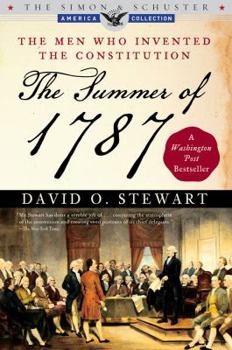
The Summer of 1787: The Men Who Invented the Constitution


Select Format
Select Condition 
Book Overview
The Summer of 1787 takes us into the sweltering room in which the founding fathers struggled for four months to produce the Constitution: the flawed but enduring document that would define the nation--then and now.George Washington presided, James Madison kept the notes, Benjamin Franklin offered wisdom and humor at crucial times. The Summer of 1787 traces the struggles within the Philadelphia Convention as the delegates hammered out the charter for the world's first constitutional democracy. Relying on the words of the delegates themselves to explore the Convention's sharp conflicts and hard bargaining, David O. Stewart lays out the passions and contradictions of the, often, painful process of writing the Constitution. It was a desperate balancing act. Revolutionary principles required that the people have power, but could the people be trusted? Would a stronger central government leave room for the states? Would the small states accept a Congress in which seats were allotted according to population rather than to each sovereign state? And what of slavery? The supercharged debates over America's original sin led to the most creative and most disappointing political deals of the Convention. The room was crowded with colorful and passionate characters, some known--Alexander Hamilton, Gouverneur Morris, Edmund Randolph--and others largely forgotten. At different points during that sultry summer, more than half of the delegates threatened to walk out, and some actually did, but Washington's quiet leadership and the delegates' inspired compromises held the Convention together. In a country continually arguing over the document's original intent, it is fascinating to watch these powerful characters struggle toward consensus--often reluctantly--to write a flawed but living and breathing document that could evolve with the nation.
Format:Paperback
Language:English
ISBN:0743286936
ISBN13:9780743286930
Release Date:May 2008
Publisher:Simon & Schuster
Length:368 Pages
Weight:0.96 lbs.
Dimensions:0.9" x 6.1" x 9.1"
Customer Reviews
4 ratings
The Mystery Surrounding the Constitutional Convention Is Made Clear
Published by Thriftbooks.com User , 18 years ago
The Summer of 1787 is simply spectacular. Stewart flawlessly weaves atmosphere, the tempers and personalities of the men at the convention, personal letters (and of course personal politics), as well as each piece of information that seems to possibly be available about the fateful Philadelphia summer into this gripping book. Without bias, this work portrays the genius, morality (although often defective - the issue of slavery played quite a significant role and this is not in any way overlooked by Stewart), integrity and diligence of the men who truly laid the governmental foundation for the United States of America. What I find to be the most compelling about this book is that Stewart, making great use of the limited historical resources available, really delves into the lives and personalities of the delegates, making the whole process seem more human. A great read for people interested in both history and modern politics. It's an old cliché, but you truly can't know where you're going until you understand where you come from, and this work concisely and effectively explains how the Constitution came about. To give yourself an edge in political debate, read this book (and the Constitution itself, of course) and truly understand the fundamental basis of your argument.
A brilliant reconstruction of an epic moment in history
Published by Thriftbooks.com User , 18 years ago
Often the "epic" moments of history that earn the attention of our best writers are battles, wars, or disasters. Luckily for us, David Stewart turned his remarkably gifted writing talents to a turning point in history where the fight was over ideas and the weapons of choice were words. The book is spell-binding. One cannot read "The Summer of 1787" without feeling as if one were present at one of those very rare moments in history where all the forces converge to make something better of us. Anyone who reads this book will never be able to say again that history is boring. When in the hands of an author like Stewart, history reads like the best novel of today. But more important than the fact the book is well written is that "The Summer of 1787" goes a long way to humanizing the Constitutional Convention. Sadly most Americans, because of the way our history is taught, regard the Convention as almost a religious moment when a group--appropriately nicknamed "Founding Fathers"--delivers to the public a document almost in the manner by which Moses brought the Commandments down from the mountain. Instead, Stewart shows how the final document was the result of politics and compromise. In other words, it was the product of mortals. This is important because as long as we regard these men as God like we will continue to raise up generations of young people who feel that such accomplishments are beyond their power. Instead, we should be leading them to believe we expect greater and better things from them. Do us all a favor and buy this book for a young person today.
philosopher kings they were not
Published by Thriftbooks.com User , 18 years ago
In a world where the talking heads are forever making pronouncements on the sacred status of what the founding fathers intended when they wrote the Constitution, this work will come as a refreshing revelation: our founding fathers had high ideals indeed, but they could also be horse traders and scheming politicos when they had to be, which was usually. Stewart has written a riveting tale of the colorful, larger than life characters, bizarre incidents and unintended consequences that created the world's greatest document, the Constitution. And best of all, it reads better than a novel.
So, you think you know how we got our Constitution?
Published by Thriftbooks.com User , 18 years ago
The author Philip Roth once said: "History is where everything unexpected in its own time is chronicled on the page as inevitable." There is a tendency among many Americans to approach the founding of the United States with this attitude. If Washington had not led the Continental Army to victory, then someone else could just as easily have done it. And if James Madison and his colleagues had not provided the impetus for the Constitutional Convention, we somehow would have still ended up with the government we have today. Those who read Mr. Stewart's fine recounting of the events of 1787 will quickly become disabused of that notion. There was nothing inevitable about the creation of our central government. Mr. Stewart tells a great story and he relates it succinctly and eloquently. Though his is certainly not the first telling of these events, he does a remarkable job of explaining the sectional differences among the delegates. Perhaps most illuminating are his descriptions of the personality quirks, prejudices and idiosyncrasies of the participants, all of which profoundly influenced the end product: our Constitution. And even though you know the outcome of the story, Mr. Stewart creates considerable suspense. More than once, you will remark to yourself: "How on earth did they ever agree on ANYTHING let alone a document that has served as the foundation for the greatest democratic experiment in history"? Highly recommended.
Copyright © 2026 Thriftbooks.com Terms of Use
| Privacy Policy | Do Not
Sell/Share My Personal Information | Cookie Policy | Cookie Preferences | Accessibility Statement
ThriftBooks® and the ThriftBooks® logo are registered trademarks of Thrift Books Global, LLC
ThriftBooks® and the ThriftBooks® logo are registered trademarks of Thrift Books Global, LLC
