


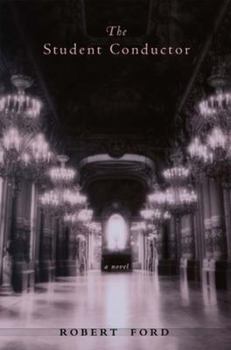
The Student Conductor

Select Format
Select Condition 
Book Overview
In this daring first novel of political, sexual, and artistic awakening, a young symphony conductor travels to Germany in the autumn of 1989, where he falls in love with a recent East German defector, and has a brutal encounter with the prewar conductor who becomes his great life teacher. Cooper Barrow has returned to the competitive fray of the orchestral world after eight years of exile-bringing his prodigious talent and insecurity into Frankfurt and Berlin just at the moment that the Berlin Wall falls. Barrow is to study under the cruel hand of a capricious maestro, Karlheinz Ziegler-a man who carries boundless shame from his days in a Nazi concentration camp, and who will force Barrow to define himself within a morally ambiguous world. But when Barrow encounters the beautiful and boldly sexual Petra Vogel, an oboist with poisonous secrets, he sets in motion a complex psychological dance of guilt, music, and love. With remarkable intensity and physicality, Robert Ford delivers a pitch-perfect debut, brimming with intrigue and revelation, where passion flowers into desire on every page.
Format:Hardcover
Language:English
ISBN:0399150374
ISBN13:9780399150371
Release Date:September 2003
Publisher:Penguin Publishing Group
Length:304 Pages
Weight:1.21 lbs.
Dimensions:9.3" x 1.1" x 6.2"
Age Range:18 years and up
Grade Range:Grade 12 and higher
Customer Reviews
5 ratings
Identity and power
Published by Thriftbooks.com User , 21 years ago
Identity and power characterize both the themes of The Student Conductor and the writing itself. Ford knows the world of classical music profoundly. Everything is depicted correctly. Astonishingly, he simultaneously captures the tremulous mindset of an American in 1989 Germany. This is a novel in the mold, curiously, of Faulkner. It is about a time and a place, but it is mostly about memory and love. Like Faulkner, Ford explores both individual and collective experiences of history as well as of life and music. While perhaps not quite on Faulkner's plane, Ford is a superb writer, though given to the occasional stiff turn of phrase. This is an extraordinary novel, and ranks with Frank Conroy's Body and Soul as one of the best fictional depictions of the world of classical music.
A Beautiful First Novel with a Classical Music Background
Published by Thriftbooks.com User , 21 years ago
I am particularly drawn to novels that have a background in the world of classical music. I loved Vikram Seth's 'An Equal Music,' for instance, with its main characters who are chamber music players. But I have to say that as much as I admired Seth's book, this one is better. It is not only startlingly apt in its insider's understanding of the world of classical musicians, but also for its complex, thought-provoking plot with its many subtly revealed secrets, and for its burnished language. Author Robert Ford was a flutist and received an MFA from Yale before becoming a writer and actor. He clearly knows from the inside about the insecurities, obsessiveness and search for transcendence so often seen in top-level musicians. He describes those qualities with spare lyricism and telling detail. (Here, for instance, is a passage about the protagonist, a violinist-turned-student-conductor now studying in Germany with a great if mysterious maestro. He has not played his violin in months but picks it up again for a day-long practice session: "Three months without playing had left his chin smooth and vulnerable. He'd been so intent on tuning intervals, one small correction after another, that he'd forgotten the need to work in a callus. He brushed a knuckle just behind the jaw bone and winced. When he looked, there was a mosquito's worth of blood on the back of his finger.") The music of Brahms figures as a leitmotiv throughout this book and it is described in detail that only a musician - and a good writer - could provide. While reading 'The Student Conductor' I kept open my own score of Brahms's Second Symphony for frequent reference, and was astonished to realize how many insights Ford gave me about the work--not something you'd expect a novel to do, is it? I also found myself referring to a couple of books that I am sure Ford used in his preparation for writing the book: Jan Swafford's marvelous biography of Brahms, and Norman Lebrecht's gossipy 'The Maestro Myth.' However the main theme of the book is not the music. It is a love story, of sorts, that takes place against the background of Germany in 1989 when the Wall fell. Not only are there ghosts from the divided Germany--primarily in the character of East German oboist Petra Vogel with whom student conductor Cooper Barrow falls in love--but from the era of Hitler's Germany whose shadow falls on Barrow's conducting teacher, Karlheinz Ziegler. Plot twists bearing on these things make the book compulsively readable. I would recommend this book urgently to readers who have some background in music. But I would also recommend it as well to those who have no such background because Ford has an ability to describe the inner lives of classical musicians in a way that makes it understandable to anyone. Plus, it's a great story. Scott Morrison
a quiet masterpiece
Published by Thriftbooks.com User , 21 years ago
Having lived in Germany for nearly 30 years, having experienced the events in November 1989 at first hand and being a historian to boot, I feel I have some insight into modern German history and the German mindset. Robert Ford's book simply took my breath away. It seems as though he has lived in this country for 30 years - so clear and accurate are his insights. The novel is multi-layered, a poignant love story, a morality tale and a brilliant description of just what it is that a conductor does and how an orchestra works. In fact it had me running to a Brahms CD that had been gathering dust for quite some time on our shelf and listening over and over to the 1st symphony with Ford's book as my guide. His description of "ordinary" people living in "extraordinary" times and the moral dilemmas they faced mirrors life in Europe in the 20th century. Needn't we be thankful that we've never been tested in this way? This is one of the best novels I have ever read - his language is spare and beautiful. I read the book twice in one week, handed it onto my daughter and checked in the internet to see whether it has been translated into German so that I can recommend it to German friends. It is being translated and will appear in German next spring. Gott sei dank!.
Not just for Maestros
Published by Thriftbooks.com User , 22 years ago
The Student Conductor is thoroughly engaging - emotionally and intellectually complex, but the prose is elegantly simple. I loved it as a window into a political culture and the world of classical music, both of which were unfamiliar terrain to me. And a wonderful love story, too. I'd recommend this book to anyone looking to be totally immersed in a vivid landscape from page one onwards.
Shattering, Musical.
Published by Thriftbooks.com User , 22 years ago
If this novel did not have a masterfully intricate plot, intriguingly human characters, and the liquid, powerful feel of absorbing a symphony in bed, I would read it for the language. The language is such that occasionally I was stopped in the middle of an established rhythm to find myself rereading a sentence, struck by how perfectly it expressed itself. My only warning to a potential reader would be to wait until you're willing to spend some time with it. With work piling up on both sides, I sat down for a break with this book and read it in its entirety within the span of an afternoon, evening, and night. Having finished, I wanted to sit down with the author - or any of his characters - over coffee. Well written, Mr. Ford.
Copyright © 2026 Thriftbooks.com
Terms of Use | Privacy Policy | Do Not Sell/Share My Personal Information | Cookie Policy | Cookie Preferences | Accessibility Statement
ThriftBooks ® and the ThriftBooks ® logo are registered trademarks of Thrift Books Global, LLC
ThriftBooks ® and the ThriftBooks ® logo are registered trademarks of Thrift Books Global, LLC
