


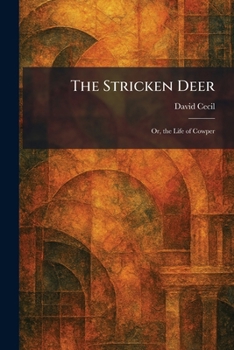
The Stricken Deer: Or, the Life of Cowper

"The Stricken Deer; Or, the Life of Cowper" is a definitive and evocative biography of the 18th-century poet William Cowper, written by the acclaimed biographer David Cecil. This work provides a deep and empathetic exploration of one of English literature's most complex figures, whose life was marked by both profound creative brilliance and intense personal struggle. Cowper, a central figure in the transition from the Enlightenment to Romanticism, is depicted here not just as a master of verse, but as a sensitive soul grappling with the heavy burdens of melancholy and religious doubt.
Cecil masterfully traces Cowper's life from his early days through his various residencies, most notably at Olney, where he composed his famous hymns and the influential long poem "The Task". The biography delves into the social and intellectual circles that surrounded him, offering a vivid portrait of the era's literary landscape. By examining the delicate balance between Cowper's gentle domesticity and his periodic descents into despair, Cecil reveals how these experiences informed the poet's unique perspective on nature and the human condition. This narrative remains a vital resource for understanding the man behind some of the most enduring lines in English poetry, celebrating his legacy and his contributions to the literary canon.
This work has been selected by scholars as being culturally important, and is part of the knowledge base of civilization as we know it. This work was reproduced from the original artifact, and remains as true to the original work as possible. Therefore, you may see the original copyright references, library stamps (as most of these works have been housed in our most important libraries around the world), and other notations in the work.
This work is in the public domain in the United States of America, and possibly other nations. Within the United States, you may freely copy and distribute this work, as no entity (individual or corporate) has a copyright on the body of the work.
As a reproduction of a historical artifact, this work may contain missing or blurred pages, poor pictures, errant marks, etc. Scholars believe, and we concur, that this work is important enough to be preserved, reproduced, and made generally available to the public. We appreciate your support of the preservation process, and thank you for being an important part of keeping this knowledge alive and relevant.
Customer Reviews
ThriftBooks ® and the ThriftBooks ® logo are registered trademarks of Thrift Books Global, LLC
