


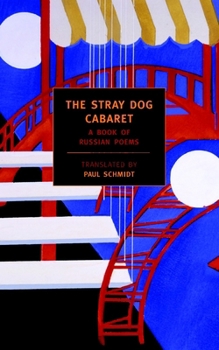
The Stray Dog Cabaret: A Book of Russian Poems


Select Format
Select Condition 
Book Overview
A New York Review Books Original A master anthology of Russia's most important poetry, newly collected and never before published in English In the years before the 1917 Russian Revolution, the Stray... This description may be from another edition of this product.
Format:Paperback
Language:English
ISBN:1590171918
ISBN13:9781590171912
Release Date:December 2006
Publisher:New York Review of Books
Length:168 Pages
Weight:0.75 lbs.
Dimensions:0.4" x 5.0" x 8.0"
Customer Reviews
2 ratings
IF YOU LIKE VODKA THIS IS VERITABLEMENT A MUST ! ! !
Published by Thriftbooks.com User , 17 years ago
This precious lil' ten-buck bouquin is the perfect and savoury intro to Russian post-revolutionary poetry ! Rated a just - and generous - 5 on the mirth side of the mirth-ennui scale, the bouquin (yeah, I keep calling it bouquin - French slang for book or old book - comes from Dutch boek) packs into its extremely well designed 140 pages simply THE BEST THERE IS ON THE SUBJECT WITHOUT LEARNING FRENCH OR RUSSIAN ! The editorial concern responsible is affiliated or belongs to the N.Y. review of books magazine (which is fine though slightly hillbilly as some American corporate journalism has become ...) and so this bouquin of theirs is really very impressive due to the thorough n.y. review professionalism of it all: great translations from 8 (!) poets, very very fine translations by Paul Schmidt (this guy was great. look him up. a wonderful icon of American post-war culture and theatre and intelligentsia. gay but married Stockard Channing. and translated Chekhov and lots of Russian literary goodies - this anthology is from his literary estate). This Stray Dog anthology also does not skimp on good and efficient knowledge tools, like a juicy introduction by Catherine Ciepiela, and a chummy afterword by Honor Moore, who knew Paul Schmidt in college (Harvard where else...). Somehow, reading these poems, you are magically transported to St. Petersburg, to the Stray Dog Cabaret (which really existed), to the dismalness of revolution and to the glory of poetry (ah... well... and if it's too much for you, there's always vodka...). A MUST ! TOP MARK IN THE MIRTH-ENNUI SCALE.
A Forgotten Flowering
Published by Thriftbooks.com User , 18 years ago
The poets here are the more prominent Futurists (Vladimir Mayakovsky, Velimir Khlebnikov, Boris Pasternak) and Acmeists (Osip Mandelstam, Anna Akhmatova, Marina Tsvetaeva) as well as the "hooligan" poet Sergei Esenin and the great late-Symbolist Alexander Blok. Though Pasternak is well known (if mostly for "Zhivago") and though a good many readers who are familiar with the crimes of Lenin and Stalin might know something *about* Akhmatova, Tsvetaeva, and Mandelstam, my strong suspicion is that most of these people aren't very widely read in the English-speaking world. This is a shame. These poets were part of the last wave of a Russian renaissance that stretched well back into the Nineteenth Century. In the generations before the Symbolists and Acmeists, we find another splendid set of writers--Fet, Tyutchev, Gippius, Annensky--as well as some very fine painters and composers. Partly because of the difficulties of rendering Russian verse into English, and partly because communists and fellow travelers would later present pre-Bolshevik Russia as a uniformly vulgar and repressive hell-hole, this cultural flowering has largely been forgotten. Paul Schmidt (who died in 1999) and the editors of this collection should be commended for doing what they can to refresh our memories. Can one find nits to pick? Well, sure. Schmidt's strength as a translator is capturing the flavor of this group of poets, and there are times when this leads him to sacrifice a lot more of the sense than I would like. Schmidt introduces, with little success, American street slang into Blok's "Twelve." In Khlebnikov's "When the winking wax-wings whistle," Schmidt's inclusion of "mockingbird" is ludicrous on both linguistic and ornithological grounds. In Mayakovsky's "Me," Schmidt actually *invents* the insipid refrain, "And it makes / me / cry," a decision that made / me / cringe. Speaking of "Twelve," I suppose it had to be included here because of its fame, but I have never been able to understand the reason for the poem's high standing, especially when so much of Blok is so much more pellucid and powerful. I have similar feelings about Tsvetaeva's "Poem of the End," and it is unfortunate that these longish poems take up so much space in "The Stray Dog Cabaret." But enough nitpicking. There is an awful lot to admire in such a slender volume. The collection starts well, with a stark imagistic piece by Blok. There are several strong Mandelstam poems in here: "This life of constant thrills will drive us crazy," "Somebody gave me this body," "Insomnia," "Leningrad," "The Poem about Stalin," and "All I want to do is escape the madness here." The Akhmatova selection is good, is mostly free of histrionics, and includes fine renderings of "There were three things in life he loved" and "I drink to the wreck of our life together." Esenin evokes the Russian countryside in a pleasingly mournful way in both "I am leaving my home in the country" and "The Backstreets of Moscow." Though I
Copyright © 2026 Thriftbooks.com Terms of Use
| Privacy Policy | Do Not
Sell/Share My Personal Information | Cookie Policy | Cookie Preferences | Accessibility Statement
ThriftBooks® and the ThriftBooks® logo are registered trademarks of Thrift Books Global, LLC
ThriftBooks® and the ThriftBooks® logo are registered trademarks of Thrift Books Global, LLC
