


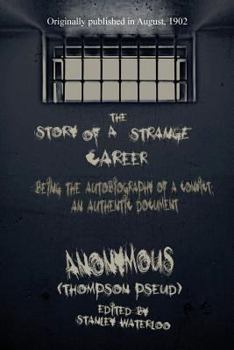
The Story of a Strange Career

Select Format
Select Condition 
Book Overview
An unusual early twentieth-century autobiographical account of crime, imprisonment, and reform, presented as the life story of a habitual criminal reflecting on the path that led him into the underworld. First published in 1902 and edited by Stanley Waterloo, The Story of a Strange Career offers a stark and often unsettling narrative drawn from the experiences of a man who spent much of his life in conflict with the law. Written with a mixture of candor, bitterness, and occasional introspection, the work attempts to explain how circumstances, environment, and personal decisions combined to shape a life of crime.
Unlike sensationalized crime stories of the period, the narrative presents itself as a personal confession rather than a detective tale. The anonymous author recounts his upbringing, early encounters with petty crime, and gradual immersion into a criminal existence that repeatedly brought him into prison. At the same time, the book serves as a social document, reflecting contemporary attitudes toward criminality, rehabilitation, and the institutions meant to control both.
Part memoir, part social commentary, The Story of a Strange Career stands as a curious artifact of early twentieth-century criminological literature, providing readers with a rare first-person account of the mindset and experiences of a self-described professional criminal.
Customer Reviews
ThriftBooks ® and the ThriftBooks ® logo are registered trademarks of Thrift Books Global, LLC
