


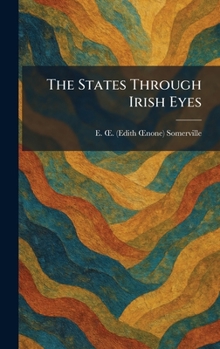
The States Through Irish Eyes

Select Format
Select Condition 
Book Overview
"The States Through Irish Eyes" is a charming and insightful travel narrative by the celebrated Irish author Edith Somerville. Known primarily for her collaborative literary works with Martin Ross, Somerville turns her keen eye and characteristic wit toward the landscape and society of the United States during the interwar period. Part memoir and part cultural observation, this work captures the author's impressions of America as she journeys through its bustling cities and scenic countryside.
Throughout the book, Somerville explores the nuances of American life, providing a unique transatlantic perspective on the era's social customs, infrastructure, and people. Her observations are marked by a blend of humor, curiosity, and the astute storytelling that defined her literary career. From the grandeur of the Hudson Valley to the hospitality of the American South, the narrative offers a vivid window into a transformative period of American history through the lens of a distinguished foreign visitor.
"The States Through Irish Eyes" remains a valuable historical document for those interested in early 20th-century travel writing, Irish literature, and the enduring cultural dialogue between Ireland and the United States.
This work has been selected by scholars as being culturally important, and is part of the knowledge base of civilization as we know it. This work was reproduced from the original artifact, and remains as true to the original work as possible. Therefore, you may see the original copyright references, library stamps (as most of these works have been housed in our most important libraries around the world), and other notations in the work.
This work is in the public domain in the United States of America, and possibly other nations. Within the United States, you may freely copy and distribute this work, as no entity (individual or corporate) has a copyright on the body of the work.
As a reproduction of a historical artifact, this work may contain missing or blurred pages, poor pictures, errant marks, etc. Scholars believe, and we concur, that this work is important enough to be preserved, reproduced, and made generally available to the public. We appreciate your support of the preservation process, and thank you for being an important part of keeping this knowledge alive and relevant.
Customer Reviews
ThriftBooks ® and the ThriftBooks ® logo are registered trademarks of Thrift Books Global, LLC
