


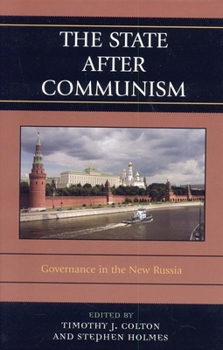
State after Communism: Governance in the New Russia
No Customer Reviews

Select Format
Select Condition 
Book Overview
The Soviet dictatorship was a strong state, committed to dominating and transforming society in the name of a utopian ideology. When the communist regime crumbled and the post-Soviet countries committed to democracy, most observers took for granted that their state structures would be effective agents of the popular will. Russia's experience demonstrates that this assumption was overly optimistic. This book, based on a major collaborative research project with American and Russian scholars, shows that state capacity, strength, and coherence were highly problematic after communism, which had major consequences for particular functions of government and for the entire process of regime change. Eleven respected contributors examine governance in post-Soviet Russia in comparative context, investigating the roots, characteristics, and consequences of the crisis as a whole and its manifestations in the specific realms of tax collection, statistics, federalism, social policy, regulation of the banks, currency exchange, energy policy, and parliamentary oversight of the bureaucracy.
Format:Paperback
Language:English
ISBN:0742539423
ISBN13:9780742539426
Release Date:August 2006
Publisher:Rowman & Littlefield Publishers
Length:334 Pages
Weight:1.15 lbs.
Dimensions:1.0" x 6.1" x 9.0"
Customer Reviews
0 rating
Copyright © 2026 Thriftbooks.com
Terms of Use | Privacy Policy | Do Not Sell/Share My Personal Information | Cookie Notice | Cookie Preferences | Accessibility Statement
ThriftBooks ® and the ThriftBooks ® logo are registered trademarks of Thrift Books Global, LLC
ThriftBooks ® and the ThriftBooks ® logo are registered trademarks of Thrift Books Global, LLC
