


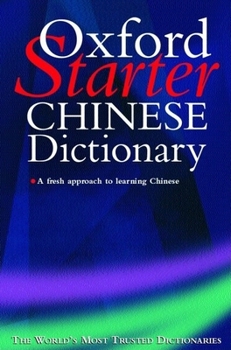
The Oxford Starter Chinese Dictionary

This revolutionary new dictionary is designed to give you a comprehensive introduction to Chinese in a completely new way. It covers all the vocabulary learners will need in their first years of study and gives unique guidance to the grammar and usage of the language.
Created specifically for beginners, this dictionary features color headwords and translations; no confusing abbreviations; and warning symbols show potential problem areas. It includes thousands of example phrases drawn from real-life situations and full romanization of the Chinese text with Chinese script following in simplified characters. It also offers a guide on how to write Chinese characters and provides full guidance on the pronunciation of Mandarin Chinese. Word patterns and constructions from language areas such as dates and telling time are grouped together to show similarities and differences.
Created specifically for beginners, this dictionary features color headwords and translations; no confusing abbreviations; and warning symbols show potential problem areas. It includes thousands of example phrases drawn from real-life situations and full romanization of the Chinese text with Chinese script following in simplified characters. It also offers a guide on how to write Chinese characters and provides full guidance on the pronunciation of Mandarin Chinese. Word patterns and constructions from language areas such as dates and telling time are grouped together to show similarities and differences.
Format:Paperback
Language:English
ISBN:0198602588
ISBN13:9780198602583
Release Date:December 2000
Publisher:Oxford University Press, USA
Length:480 Pages
Weight:1.10 lbs.
Dimensions:1.0" x 5.1" x 7.8"
Customer Reviews
5 ratings
Well-designed dictionary; a limited vocabulary is the trade-off for clarity
Published by Thriftbooks.com User , 20 years ago
As others have said, this is a very clear and easy to use dictionary. The use of blue type for the headwords makes the layout very clear, and a reasonable size font is helpful, as is the giving of measure words for Chinese nouns in the English-Chinese section. The dictionary also deals helpfully with function words and has a number of breakout "topic-based" entries in the English-Chinese section. For example, the verb to "play" a musical instrument depends in Chinese on how the instrument is played (blown, touched, bowed, for example), and there is an entry on "musical instruments" which summarises this (though not comprehensively, it doesn't extend to instruments which are beaten!), which might otherwise be hard to divine from just looking up "play" in other dictionaries. Other "breakout" sections deal with more functional issues (such as "Quantities" or "Not") and these are cross-referenced by page number from head-word entries. The Chinese-English section directs you to alternative pronunciations for hanzi with more than one sound (this is not so unusual) but also occasionally warns of traps or difficulties of a "dictionary-ese" nature which an English speaker might easily fall into. When I was studying in Beijing (at an elementary but not beginner level) this dictionary attracted envy from my classmates. It really is streets ahead of its competitors in concept and design. I never saw it in a book shop in China, probably because it really it is specifically for learners of Chinese, rather than trying to serve equally (as many other dictionaries do) Chinese learners of English. It is a good size for quick class-room reference and also for browsing related words. The trade-off for this is that the vocabulary is rather limited: you will need to have a more comprehensive dictionary (and possibly a magnifying glass to use it) for reference purposes, but you can probably safely leave that at home until you reach intermediate level. Because the vocab is limited, there will always be arguments about which words should be included or not. To me, for example, the omission of "Visa" in the English-Chinese section is pretty extraordinary, though it's probably true that in places where you need to talk "visa" the English word will also be known. The point is, this is a useful portable and legible (I don't need glasses for even very small type in English, but those tiny Hanzi are a challenge once they get at all complex so that the "zang" in Xizang=Tibet remains a blur for me in a smaller typeface) dictionary which you can look up quickly. This dictionary is not an absolute substitute for a fuller dictionary, but compared to the amount of time you will need to spend learning Chinese, the expense of having more than one dictionary is absolutely marginal, and the convenience of this dictionary is well worth it.
Wish I Had It a Year Ago
Published by Thriftbooks.com User , 22 years ago
I've just completed my first two semesters studying Mandarin and they would have been a lot easier if I had had this dictionary from the beginning. Everyone says how easy Mandarin grammar is and that may be true relative to other languages (and relative to learning Chinese characters!), but you still need to learn quite a bit of Mandarin grammar before you can start formulating sentences. I always felt very uncomfortable doing my homework (translation from English to Chinese) because I didn't know whether I was using the grammar properly or not and had no way of checking. I was worried about accidentally getting into bad grammatical habits without even knowing it, because my textbook (Integrated Chinese) has really very little usage information and neither did the dictionaries I had on hand.Once I got "The Starter Oxford Dictionary," however, homework became so much easier and I no longer feel insecure about sentence formulation. The emphasis in this dictionary is on usage, so instead of having tons and tons of words (which you can get from a regular dictionary), it has a fewer number of words with their usages very clearly explained and illustrated. For example: the entry for the English word "can": "Oxford Starter" divides "can" into three subcategories: "to have the possibility" (translated as neng); "to know how to" (hui); "to be allowed to" (keyi). The "neng" entry then gives two illustrative sentences "Can he come?/Ta neng lia ma?" and "Where can I buy stamps?/Wo zai nar neng maidao youpiao?" The "hui" subcategory has three such illustrative sentences and the "keyi" has four. There are also two warnings on translating "can," one for "hui" and one for "keyi": "Note that when talking about the ability to speak a language, whether or not "can" is used in English, "hui" is required in Chinese" and "Note that to negate, you have to use "bu neng" rather than "bu keyi."Odds are, if you're studying Chinese, you're a bibiophile, too, so probably you don't need a lot of convincing to buy yet another Chinese dictionary. But in praise of this work I have to say that, if I could have only one book to help me learn elementary Mandarin, this would be it.(Note: "The Oxford Started Chinese" does use only simplified characters. However, I am learning with traditional and found it wasn't that difficult to figure out what the traditional equivalents were, especially since the entries are organized by pinyin. It would be nice to have a traditional edition but I still wholeheartedly recommend the simplified.)
Highly Recommended!!
Published by Thriftbooks.com User , 23 years ago
As a "beginning" student of Chinese for a few years now, I have gone through a large number of Chinese language resources. This is one that I would unhesitatingly recommend to anyone.The dictionary is at the right level for beginning students. The entries are limited to the most commonly used words. This is a major advantage for those who like to learn vocabulary by browsing a dictionary -- you are sure to be learning useful words (as opposed to specialty or infrequently used words). There have been only a few times where I have look for a word that wasn't included in this dictionary. I expect that the casual learner of Chinese will not outgrow this dictionary for at least a year or two. I found the format of the dictionary extremely uncluttered and user friendly. In addition to the standard word and definition, entries also include very useful notes of clarification. For example, after the character for hui4 ("to be able to") there a note explaining that this character can also be pronounced as kuai4 with a different meaning.Another resource I have been extremely pleased with and highly recommend is, "Chinese Character Flashcards 888." Good luck in your studies!!
Great for beginners
Published by Thriftbooks.com User , 24 years ago
This dictionary is exactly what the beginning student of Mandarin Chinese needs. It's specifically targeted at English speakers who are just beginning to study Chinese. To that end, the size of the vocabulary is limited to just what you need as a beginner; there are numerous detailed usage and grammar notes throughout the dictionary; almost every entry has example phrases or sentences; all Chinese is given in both Pinyin and characters; and perhaps best of all - it's extremely clear, well-designed, and easy to read. My only complaint is that there is no index of traditional characters (all characters are simplified)...but that doesn't really detract from the quality of this dictionary.
Oxford finally gets it right!
Published by Thriftbooks.com User , 25 years ago
This is the best Chinese/English dictionary I've found so far. It's a beginner's dictionary, but hopefully Oxford University Press will learn from this one and apply the same quality standards to their more extensive, but miserably formatted and somewhat inaccurate "Concise English-Chinese Chinese-English Dictionary". This dictionary is very easy to read. The lookup words are in large, blue print. Multiple definitions are bulleted and numerically categorized by noun, adverb, etc. Word definitions also contain the Chinese characters and examples of usage. There are radical and character indices, rules for writing characters, and a section on measure words. The English to Chinese section also contains the measure words in the definitions, as well as British and U.S. English spellings if there is a difference. There are also many language usage tips throughout the dictionary.
Copyright © 2026 Thriftbooks.com Terms of Use
| Privacy Policy | Do Not
Sell/Share My Personal Information | Cookie Policy | Cookie Preferences | Accessibility Statement
ThriftBooks® and the ThriftBooks® logo are registered trademarks of Thrift Books Global, LLC
ThriftBooks® and the ThriftBooks® logo are registered trademarks of Thrift Books Global, LLC
