
Skip to content
Scan a barcode
Scan
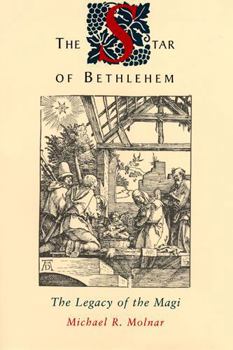
Paperback The Star of Bethlehem: The Legacy of the Magi Book

ISBN: 0813564719

ISBN13: 9780813564715

The Star of Bethlehem: The Legacy of the Magi

Select Format

Select Condition ThriftBooks Help Icon

Recommended

Format: Paperback

Condition: New

$27.68
Save $5.27!
List Price $32.95
Ships within 2-3 days
Save to List

Book Overview

Could the $50 purchase of an ancient coin by a Rutgers astronomer have unlocked the mystery of the Christmas Star? For years, scientists have looked, with little success, to astronomical records for an explanation of the magical star that guided the Magi to Christ's manger. Intrigued by the image he found on the latest addition to his coin collection, Michael Molnar thought there might be more to learn by looking, instead, at the teachings of ancient astrologers.

Molnar argues in his book that the Star of Bethlehem was not a star at all, but rather a regal portent centering around the planet Jupiter that was eclipsed by the moon. He bases this theory on the actual beliefs of astrologers, such as the Magi, who lived around the time of Christ. Molnar found some intriguing clues to the mystery while researching the meaning of astrological symbols he found an ancient coin, which bore the image of Aries looking back at a star. He found that Aries was a symbol of Judea at the time, and that ancient astrologers believed that a new king would be born when the moon passed in front of Jupiter. Molnar wondered, could the coin have been issued as a response to the Great Messianic Portent, the Star of Bethlehem?

To match the story of the appearance of the Christmas star, Molnar also knew the event had to happen when Jupiter was "in the east." Using these criteria and a computer program, he was able to chart an eclipse of Jupiter in Aries on April 17, 6 B.C., a day when Jupiter was precisely "in the east," which confirmed his theory. Moreover, he found that a Roman astrologer described the conditions of that day as fitting the birth of a "divine and immortal" person.

According to Harvard University Professor Owen Gingerich, "this is the most original and important contribution of the entire 20th century" about the Magi's star. Using clues from astronomy, astrology, and history, Molnar has created a provocative, fascinating theory on the Christmas Star. He weaves together an intriguing scientific detective story which resolves one of the world's greatest mysteries: The Star of Bethlehem at the birth of Christ.

Customer Reviews

5 ratings

An Astronomer Looks for The Star of Bethlehem

Michael R. Molnar, a PhD astronomer, convincingly argues that the identity of the star of Bethlehem has to be sought from the astrological perspective that held sway at the time and place of the birth of Jesus. He studied that astrology in depth and conveys it to the readers of his book. Molnar also describes relevant aspects of the ancient cultures of Rome, Judea and the East, so that the reader can follow his reasoning. His investigation deftly combines ancient astrology and history with modern astronomical calculations of planet and star positions 2000 years ago. THE STAR OF BETHLEHEM: THE LEGACY OF THE MAGI concludes that an astrological portent involving Jupiter and the Moon in the zodiacal constellation Aries was the 'star' that lead the Magi to Jesus. The book has a Christian and Western flavor but is respectful of other religions and cultures. The writing style is quite clear and pleasing to read.

WOW! First new research result on Star in 400 years!

Molnar's book has given me one of the few 'conversion' episodes in my life. He has shown that all the previous claims about the Star of Bethlehem are provably wrong. The simple reason is that they are all *astronomical* spectaculars (that would impress modern astronomers) while the only people who need to be impressed are the *Magi* (i.e., Persian astrologers) who only pay attention to *astrological* spectaculars. That is, there is no place for a comet on a horoscope, the Magi would never have looked up to spot a supernova, and triple conjunctions are astrologically meaningless. Wow, Molnar is right! The application of modern ideals to ancient situations is an easy and deadly trap, and now Molnar is showing that all previous research of the Star is totally wrong. I feel embarrassed for myself and for the historical/astronomical community at not realizing that the Emperor really had no clothing. Constructively, Molnar next shows what the Star must have been - based on what the *Magi* would have considered as important. As astrologers, they would take the Star to be a horoscope indicating the birth of a very great king in Judea. For the last decade, Molnar's scholarly articles have worked on many points of ancient astrology, where many surviving books tell us exactly what is needed for a regal horoscope and what would point to Judea. Molnar searches over a long range of time to find the one time when all the portents point to a very great king to be born in Judea. And the date fits well with all historical evidence. So I strongly conclude that Molnar has indeed correctly identified the Star of Bethlehem. The implications of Molnar's discovery are less clear. For example, it does not decide on the divinity of Christ. Nor does it decide on the details of what actually happened. Possibilities range from the traditional Christian story all the way to a Greek convert around AD 70 discovering the omen of Jesus only by back calculation. Molnar's Star of Bethlehem is a set of around ten items that the horoscope should show. Only one of these items is that the Moon and Jupiter should be in conjunction. This conjunction happens once a month as the Moon goes around the zodiac. Molnar's thesis does not require in any way the existence of a lunar occultation of Jupiter, although the astrological significance would increase with zero separation. It is fully adequate that the Moon pass by Jupiter at any distance, which it certainly did. It is also adequate that the Magi could have gotten the Moon's position accurate to within a few degrees, and this was easily done in ancient times. In *modern* times, there indeed is a roughly one hour uncertainty in the time of the occultation (as was well known to Molnar), but this is totally irrelevant to Molnar's thesis. However, the *existence* of the occultation is certain, as can be confirmed from Tuckerman's tables, Voyager calculations, or the Chapronte-Touze & Chapront integrations. I have publi

Surprising and worthwhile!

This book surprised the heck out of me. I expected another typical rundown of the usual astronomical suspects (comets, supernova, planetary massings and conjunctions, etc.) but was pleasantly surprised to find instead a very serious and scholarly treatment of first century astrology. As a certified skeptic, I've always given fairly short-shrift to astrology in general, but until reading Molnar's book, I don't think I ever understood how truly complex and technical it is. Certainly the "science" of the ancient world, Molnar argues that without such an understanding of astrology, the biblical clues as to the identity are simply missed by virtually all researchers of the star of Bethlehem. For good reason, most astronomers and biblical scholars have largely avoided the role of astrology other than casual mentions. Instead, they have focused on astronomical phenomena that are visually striking, and which they believe would have been meaningful to the visitors from the east.Molnar takes the astrological bull by the horns, and, combined with the very novel angle of first century coinage, provides a compelling and persuasive new theory of the true nature of the Matthean "star." Briefly, Molnar points to the language of the original Greek text of Matthew 2, and identifies unmistakable allusions to a star's helical rising, and to features of a planet's "retrograde" motion (he argues that the Greek for "went before" and "stood over" are clearly references to a retrograde loop and stationary point).In a very well documented and easily readable account, Molnar traces the evidence to a helical rising and subsequent lunar occultation of Jupiter in April of 6 BC. After this event, which took place in the constellation of Aries, Jupiter proceeded to travel east, go retrograde, and resume its eastward journey over the next several months. Though the occultation would not have been observable (it happened after noon on April 17th), Molnar argues that this is inconsequential since all astrology was done via charts based on Ptolemy's tables of planetary positions anyway. Astrologers were much more interested in the significance of their charts and rarely made any effort to observe the events they portrayed. Furthermore, many significant astrological events are visually unimpressive even if they are observable.I don't know if Molnar is right. Others take the approach that the star must have been a series of conjunctions or nova phenomenon (Kidger and Hughes). Some say the whole event is a myth (Gardner). Molnar's contribution is certainly worth reading and has gained the approval of some fine authorities (Gingerich and Trimble both wrote jacket reviews).

A novel approach to a perennial enigma.

The Star of Bethlehem is a perennially favorite topic for planetarium shows, articles, musings, sermons, and books. What could be left at this late date to say about it? Quite a lot, actually. Enough so that two new books, both titled "The Star of Bethlehem" (How original!) and both copyright 1999 are on my desk as I write.The story about the Star is found only in the Gospel of Matthew. There are three possibilities: 1) The star was a myth - invented by the writer of Matthew or earlier Christians whom he followed, in order to give Jesus appropriately royal auspices for his birth. 2) The star was a miracle provided by God to guide the Magi, even perhaps visible only to them. 3) The star was a natural astronomical event or events. These three are obviously mutually exclusive and exhaustive. If either of the first two possibilities are correct, there is little more to be said; therefore both of our authors give them short shrift.Both books cover some of the same material in about the same way. Jesus was *not* born on December 25 of 1 BC as worked out by the Scythian monastic scholar Dionysius Exiguus (Denny the Dwarf) in 525 AD. King Herod, of whom the Magi inquired about the birth, died in 4 BC. For other reasons, the birth is fairly firmly dated to between 6 and 4 BC. If the shepherds were `abiding with their flocks by night', the birth did not take place in December. For various reasons, these authors agree that Spring is more likely."The Star of Bethlehem - An Astronomer's View", by Mark Kidger, gives a review of all the various suggestions that have been made over the years, finally settling on a combination of events being the sign: a triple conjunction of Jupiter and Saturn in Pisces (the sign Kidger says is associated with the Jews - more on this later) between May and December of 7 BC, with Mars approaching this pair in February of 6 BC, followed by a near-occultation of Jupiter by the Moon in Pisces in February of 5 BC, and then, possibly a nova in March/April 5 BC, as suggested by some Korean and Chinese records.I would have found this scenario plausible were it not for the second, and to my mind more interesting, book: "The Star of Bethlehem - The Legacy of the Magi" by Michael R. Molnar. There are two problems, as pointed out by Molnar, with the kinds of solutions reviewed, and those eventually suggested, by Kidger. Firstly, they tend to focus on what we as moderns would find to be visually compelling sights in the heavens. But this neglects the fact that the Magi were certainly *astrologers*, most likely Hellenistic rather than Babylonian in their astrological theories. Most of the events put forward would not have been significant to contemporary astrology. Kidger himself makes this point but does not seem to follow through with a close study of Hellenistic astrology as Molnar has made. Secondly, we have the advantage over the Magi of *knowing*, at least approximately, what the correct time frame

A serious and unbiased inquiry into an old mystery

I found Michael Molnar's investigation into the mystery of the magi's star unqiue in a very important way. Unlike other writers on this topic, his approach involves entering the ancient world by examining the intellectual currents of the time. He does not impose our modern presumptions of how people thought back then on the evidence available, as others have done before him. As the book progresses, we find Molnar introducing the astrology of the times to better illuminate the cryptic and confusing passages of the Magi's star that we all know from the Bible. This, to my knowledge is unique. Most academic researchers steer a wide path around astrology and attempt to make their cases without it. But without a thorough account of the astrologer's point of view, which was at that time a very respectable way of knowledge, and which is clearly what the subject itself is all about, we miss an opportunity to get at the heart of the matter. Michael Molnar does not miss this opportunity. I was impressed with this book because he tackles a controversial subject intelligently, and comes out unscathed with a most compelling argument. If only other ancient historians and historians of science were as honest in their assessment of the astrologically rich perspectives of those times.
Copyright © 2026 Thriftbooks.com Terms of Use | Privacy Policy | Do Not Sell/Share My Personal Information | Cookie Policy | Cookie Preferences | Accessibility Statement
ThriftBooks® and the ThriftBooks® logo are registered trademarks of Thrift Books Global, LLC

GoDaddy Verified and Secured