


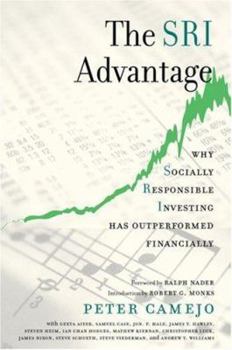
The SRI Advantage: Why Socially Responsible Investing Has Outperformed Financially

Socially responsible investing (SRI) is investing that is mindful of the impact on society of that investment. It is often described to investors as allowing them "to do well by doing good." SRI... This description may be from another edition of this product.
Format:Hardcover
Language:English
ISBN:0865714770
ISBN13:9780865714779
Release Date:September 2002
Publisher:New Society Publishers
Length:352 Pages
Weight:1.38 lbs.
Dimensions:9.5" x 1.0" x 6.5"
Related Subjects
20th Century Business Business & Investing Economics Ethics Finance Investing Popular EconomicsCustomer Reviews
1 rating
socialfunds.com says...
Published by Thriftbooks.com User , 23 years ago
Book Review: The SRI Advantage by Doug Wheat In this important new book, author Peter Camejo makes a case for why socially responsible investing strategies lead to higher returns than non-SRI strategies. SocialFunds.com -- With the completion of The SRI Advantage, Peter Camejo has filled a large gap in the existing literature about socially responsible investing. Previous books have concentrated on how one can and why one should participate in social investing, often from ethical or moral perspectives. Mr. Camejo's contribution is focused squarely on dispelling a widely held myth that SRI investments do not earn competitive returns. Mr. Camejo is very well versed in SRI strategies. He is the founder and chair of Progressive Asset Management, an investment firm that specializes in SRI. According to Mr. Camejo, SRI strategies enable investors to reduce company-specific risks in a portfolio. SRI strategies also allow investors to identify firms with strong finances and effective management. For example, SRI strategies weed out companies that harm society, such as those that sell tobacco or emit pollution from their factories. Moreover, the author states that SRI strategies identify companies that are less likely to develop unforeseen problems. These strategies also detect companies that are likely to possess financial and managerial resources that can "respond effectively to traditional business challenges." In addition, the author posits that using SRI strategies sensitizes the investment process to the social concerns of society. In essence, SRI strategies screen out companies that are in conflict with public opinion. The result, he states, is that socially responsible investments financially outperform investments that are not socially responsible. Ultimately, Mr. Camejo asserts that outperformance results because "SRI sees an aspect of reality not included in the research of traditional Wall Street firms." This concept is important because it allows the author to designate SRI strategies as a financial screen. When SRI strategies are viewed as a financial screen, the explanation of their ability to yield outperformance fits within accepted financial theories. This logic may make SRI more palatable to financial analysts and institutional investors than when the strategies are marketed as "socially responsible." Mr. Camejo writes, "Wall Street's traditional view is that you can add alpha (performance), but that SRI does not because it uses screens that are external to financial performance. But Wall Street is wrong in this judgment, precisely because SRI is a financial screen." The recent jury award of $28 billion from Phillip Morris to a smoker must surely give pause to analysts who think every portfolio should have a slice of tobacco because it passes traditional financial screens. Mr. Camejo does a commendable job presenting some complicated financial material. However, lay readers may find themselves lost in a sea of alphas and betas while
Copyright © 2026 Thriftbooks.com
Terms of Use | Privacy Policy | Do Not Sell/Share My Personal Information | Cookie Notice | Cookie Preferences | Accessibility Statement
ThriftBooks ® and the ThriftBooks ® logo are registered trademarks of Thrift Books Global, LLC
ThriftBooks ® and the ThriftBooks ® logo are registered trademarks of Thrift Books Global, LLC
