


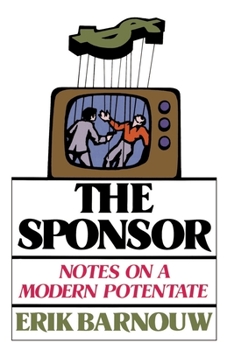
The Sponsor: Notes on a Modern Potentate


Select Format
Select Condition 
Book Overview
Erik Barnouw, leading historian of broadcasting in the United States, in 'The Sponsor' confronts the touchy, far-reaching issue of how the television industry has gradually meshed itself into the needs and wishes of sponsors--influencing programming, news and documentaries, and shaping American culture, mores and politics.
Format:Paperback
Language:English
ISBN:0195026144
ISBN13:9780195026146
Release Date:September 1979
Publisher:Oxford University Press, USA
Length:240 Pages
Weight:0.25 lbs.
Dimensions:0.5" x 5.3" x 7.9"
Customer Reviews
2 ratings
Historic Contribution to Media History
Published by Thriftbooks.com User , 18 years ago
Chronologically the beginning is a good place to start and Barnouw starts with KDKA, Pittsburgh, the nation's first radio station. From this point the entire telecommunications system branched out, grew, made moderations and exploded into the information age. Tidbits on what were important issues of the time are humorous in retrospect. For example, at WEAF in New York there was discussion on whether something so personal as toothpaste should be advertised over the public airwaves. Critics such as Edgar Felix argued that "direct advertis(ing)" itself was resented by the public. As commercialization increased, the behind-the-scenes decision makers gained more control over the system. "Many programs were advertising agency creations, designed to fulfill specific sponsor objectives," Barnouw tells us. PSAs (Public Service Announcements) followed campaigns designed to support the military in World War II. As the decades rolled on and power was concentrated in the networks, the U.S. Department of Justice filed an antitrust suit against the ABC, CBS, and NBC which charged them with monopolizing prime time entertainment. Television news began as 15 minute segments and was expanded to 30 minutes in 1963. This book is informative and well-written. It explains how the foundations of the modern information society came about.
The History of Sponsorship in America!
Published by Thriftbooks.com User , 25 years ago
Really an excellent book. Traces the history of electronic communication (radio & TV)and with it the development of "This show is brought to you by.........."
Copyright © 2026 Thriftbooks.com Terms of Use
| Privacy Policy | Do Not
Sell/Share My Personal Information | Cookie Policy | Cookie Preferences | Accessibility Statement
ThriftBooks® and the ThriftBooks® logo are registered trademarks of Thrift Books Global, LLC
ThriftBooks® and the ThriftBooks® logo are registered trademarks of Thrift Books Global, LLC
