


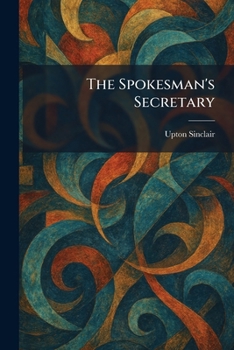
The Spokesman's Secretary

Select Format
Select Condition 
Book Overview
"The Spokesman's Secretary" is a sharp-witted political satire by the renowned social critic and novelist Upton Sinclair. Written in the form of letters from Mame, a clever manicurist from a Washington hotel who unexpectedly finds herself working as the secretary to the official "Spokesman" for the President of the United States, the work provides a humorous yet biting look at the inner workings of American government and high society in the 1920s. Through Mame's correspondence with her mother, Sinclair exposes the pretensions, absurdities, and behind-the-scenes manipulations of the political elite.
The novel serves as both an entertaining character study and a scathing critique of the Coolidge-era administration. Mame's unique perspective-moving from the world of beauty treatments to the corridors of power-allows Sinclair to highlight the disconnect between official government rhetoric and the reality of political life. As Mame navigates the social ladder and the complexities of political communication, readers are treated to a masterclass in irony and social commentary. "The Spokesman's Secretary" remains a significant example of Sinclair's ability to combine popular fiction with deep-seated social observation, offering a timeless reflection on the intersection of power, image, and the American dream.
This work has been selected by scholars as being culturally important, and is part of the knowledge base of civilization as we know it. This work was reproduced from the original artifact, and remains as true to the original work as possible. Therefore, you may see the original copyright references, library stamps (as most of these works have been housed in our most important libraries around the world), and other notations in the work.
This work is in the public domain in the United States of America, and possibly other nations. Within the United States, you may freely copy and distribute this work, as no entity (individual or corporate) has a copyright on the body of the work.
As a reproduction of a historical artifact, this work may contain missing or blurred pages, poor pictures, errant marks, etc. Scholars believe, and we concur, that this work is important enough to be preserved, reproduced, and made generally available to the public. We appreciate your support of the preservation process, and thank you for being an important part of keeping this knowledge alive and relevant.
Customer Reviews
ThriftBooks ® and the ThriftBooks ® logo are registered trademarks of Thrift Books Global, LLC
