


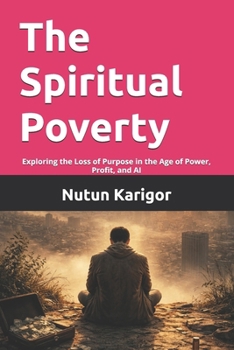
The Spiritual Poverty

Summary
"The Spiritual Poverty: Why Modern Wealth Fails to Feed the Human Soul"
The Spiritual Poverty explores a paradox of modern life: unprecedented material progress has coincided with a deepening inner emptiness. While societies measure success through income, growth, technology, and consumption, the book argues that the most destructive form of deprivation today is not economic poverty but spiritual poverty-the loss of meaning, moral clarity, compassion, and transcendence in individual and collective life.
The book defines spiritual poverty as a condition in which human beings become disconnected from purpose, ethical responsibility, and higher values, even while enjoying material comfort. It manifests in anxiety, greed, loneliness, moral indifference, and the normalization of injustice. Unlike material poverty, spiritual poverty often remains invisible, yet it silently shapes institutions, politics, markets, and personal relationships.
A central argument of the book is that modern development models, when detached from moral and spiritual foundations, intensify this poverty. Economic systems reward accumulation without accountability; political systems prioritize power over service; and technological progress advances efficiency while neglecting wisdom. As a result, societies experience ethical erosion, widening inequality, environmental destruction, and a crisis of trust-symptoms rooted in spiritual deprivation rather than mere policy failure.
Drawing heavily on Islamic ethical thought, the book contrasts spiritual poverty with the Qur'anic vision of human dignity, balance (mīzān), and purpose (maqāṣid). It emphasizes that wealth without justice, knowledge without humility, and power without accountability are forms of misguidance. From this perspective, true prosperity (falāḥ) requires the integration of material well-being with moral consciousness, social responsibility, and remembrance of God.
The book also examines how spiritual poverty operates at the institutional level. Corruption, disguised exploitation, form-based religiosity, and performative ethics are presented as outcomes of institutions that have lost their moral soul. When spirituality is reduced to ritual without justice, or religion becomes a tool of legitimacy rather than transformation, spiritual poverty deepens even in religious societies.
Another key theme is the relationship between need and greed. The book argues that modern systems deliberately blur this boundary, encouraging unlimited desire while suppressing ethical restraint. Spiritual poverty thrives where greed is normalized and contentment (qanā'ah) is ridiculed. This distortion fuels consumerism, debt, exploitation of the poor, and ecological imbalance.
Importantly, The Spiritual Poverty does not romanticize hardship or reject material progress. Instead, it calls for a reorientation of development-one that places ethics, spirituality, and human dignity at its core. The book highlights concepts such as zakāt, social justice, trust (amānah), and accountability as practical tools for addressing both spiritual and material deprivation simultaneously.
In conclusion, the book presents spiritual poverty as the hidden crisis of the modern age and argues that no sustainable solution to economic inequality, political corruption, or social fragmentation is possible without addressing this inner void. By reconnecting faith, ethics, and public life, The Spiritual Poverty offers a framework for restoring meaning, justice, and balance in an age overwhelmed by material excess but starved of the soul.
Dr. Mahmood Ahmed (Nutan Karigor) writes thought-provoking books on ethics, faith, social justice, and leadership in the age of AI-bridging spirituality, economics, and human dignity to help readers think clearly, live meaningfully, and act responsibly.
Customer Reviews
ThriftBooks® and the ThriftBooks® logo are registered trademarks of Thrift Books Global, LLC
